


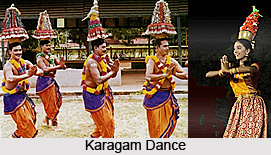
 Karagam dance is a folk dance performed in the Tamil Nadu state of India. It is believed that Karagam is originated in Thanjavur, a village in Tamil Nadu. The villagers perform this dance in praise of the rain goddess "Mari Amman" and the river goddess "Gangai Amman" as a part of their custom. The idol of Mariamman is carried in procession. This ritual is performed in the month of August. The dance is very popular in Tamil Nadu for its intricate movements and the way dancers balance pot on their heads. Thousands of people comprising local as well as tourist witness this dance. Karagam dance is a folk dance performed in the Tamil Nadu state of India. It is believed that Karagam is originated in Thanjavur, a village in Tamil Nadu. The villagers perform this dance in praise of the rain goddess "Mari Amman" and the river goddess "Gangai Amman" as a part of their custom. The idol of Mariamman is carried in procession. This ritual is performed in the month of August. The dance is very popular in Tamil Nadu for its intricate movements and the way dancers balance pot on their heads. Thousands of people comprising local as well as tourist witness this dance.
Performance of Karagam Dance In the Karagam dance, intricate steps and body/arm movements decides the skill of the performer. This dance can be performed individually or in pairs, by both the genders. Some of the steps that are widely used are similar to the circus acts; dancing on a rolling block of wood, up and down a ladder, threading a needle while bending backwards and many more. In this dance, the performers balance the water pot on their head beautifully. However, the pots have transformed from mud pots to bronze ware and even stainless steel. The pots are decorated in many ways with the help of attractive flower arrangements, topped by a moving paper parrot. The parrot rotates as the dancer takes swings. When men perform this dance, they balance the pots filled with uncooked rice, surrounded by a tall conical bamboo frame decorated with colourful flowers. Musical Instruments of Karagam Dance The instruments that accompany this dance comprise of drums and long pipes. These musical instruments add vigour to the dance and make it look beautiful and sound rhythmic. Types of Karagam Dance Traditionally, this dance is performed in two types - Aatta Karagam is danced with decorated pots on the head which symbolizes joy and happiness, while the Sakthi Karagam is performed only in temples and is mainly danced for entertainment. Earlier, it was performed only with the accompaniment of the Naiyandi Melam, but now it also includes songs. Most expert artistes are from the regions of Thanjavur, Pudukottai, Ramanathapuram, Madurai, Tirunelveli, and Pattukottai and Salem. |
| |||



Home > Art & Culture > Indian Dances > Folk Dances of Indian States > Folk Dance of Tamil Nadu > Karagam Dance
Karagam Dance
| Karagam dance is the most popular folk dance form of Tamil Nadu. In this dance, the performers balance water pot on their head beautifully. |
| ||||||||||||||||||||||||||||

