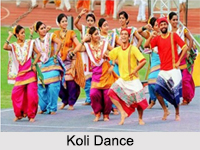
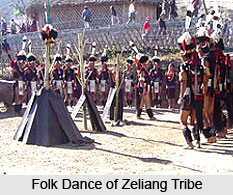
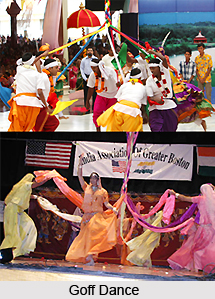
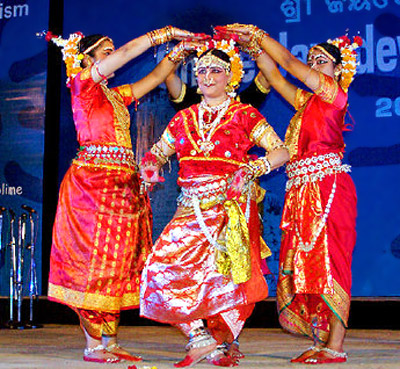
Garba dance is originally a popular folk dance of Gujarat. This dance form has connection with Shakti-Puja and its origin is believed to be in the worship of goddess Jagdamba. It is played in a circular form performed by ladies on the nine nights of Navaratri festival, Sharad Purnima, Vasant Panchami, Holi and such other festive occasions and it continues till midnight. The word Garba is derived from the word `Garbha Deep` (a lamp inside a perforated earthen pot). The light inside the perforated earthen pot symbolizes the embryonic life. This also signifies value of knowledge (light), as opposed to the darkness (ignorance). It is said that just as Lord Krishna popularized the Ras dance, Usha the grand daughter-in-law of Lord Krishna is credited to have popularized Lasya Nritya, which is known today by the name of Garba dance.
In this folk dance, the women place the pot known as Garba with the lamp on their heads and move in circular direction, singing and clap at the same time or even snap their fingers, to the accompaniment of folk instruments. A betel nut and a silver coin are placed within the pot, termed as Kumbh, on top of which a coconut is placed. Even in some villages of Gujarat, one would find the tradition of a "Light" (Deevo-Kodiyun) in an earthen pot with the holes all around, placed in the center on a stool and colourful dressed ladies dancing around it by clapping their hands and singing Mataji`s songs. Garba songs are devotional mostly in praise of Mother Goddess Jagdamba describing her form, powers, and invoking her blessings. But in some songs description about seasons and social themes of domestic life is also found. Folk poets compose Garba songs, which are lyrical poems sung in praise of Lord Krishna. Singing together is an invariable accompaniment of Garba Nrtiya. Other forms of Garba are Deevo, Ghado and Garbi.
The actual dance performance begins at night and all the participants gather at the open space or at street corners. An idol or photograph of the goddess is kept in the centre and a circle is formed around it. Ghee and oil amps are lit in front of Mataji`s Sthanak, which is put in the Chowk. At initial stages dancing begins with slow tempo and reaches at a fast tempo. A Dholi or drummer who sit in the centre keeps the rhythm. Some times, the women also carry `Mandavali`, on their heads and it is made up of bamboo chips covered with a red silk piece of cloth. The Mandavali symbolizes the goddess and they dance with it for some time and later put it in the centre.
Generally, in Gujarat, the women wear sari in their Gujarati style. However, in different parts of Gujarat, every community wears different style of clothes. In Saurashtra region, women wear artistically embroidered petticoats (Ghaghara), a backless choli (Kapdu) and a head cover (odhani) with lots of silver on their head. Males wear Kediyum (shirt) Vajani (trouser) and Rumal a printed headpiece with on the waist, neck and hands. The musical instruments used for Garba are mainly the drum, harmoniums and Nal.