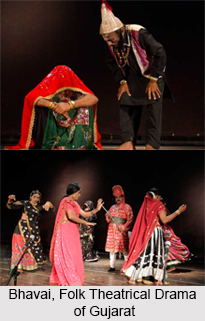
 Bhavai is a popular form of folk theatre of western India, especially Gujarat. It is as much a dramatic form of entertainment as it is a kind of ritual offering made to the Hindu goddess Amba. The genesis of Bhavai is traced back to the 14th century and a Brahmin priest, Asaita Thakar, is traditionally credited for its origin.
Etymology of Bhavai
According to scholars, the term "Bhavai" is a concoction of two words - "Bhava" meaning universe and "Aai" meaning mother, literally referring to the mother of the universe, Goddess Amba. The term is also believed to have been derived from the Sanskrit word "bhava", which means expression of emotion or feeling. Thus, Bhavai is considered as an art of expression through emotions as much as homage devoted to Goddess Amba. Another interesting definition of Bhavai comes from the term"s three letters of Bha-va-I, symbolizing the Past, Present and Future. Thus, through Bhavai the performers try to interpret the present based on learning from the past while depicting future scenarios. The plays enacted in the Bhavai are also known as "Vesha" or "Swang".
Origin and History of Bhavai
In the 14th century, the beautiful daughter of Unza village"s headman Hemala Patel, Ganga, was kidnapped by a Muslim Subhedar. Their family priest, Asaita Thakar, who was a Brahmin, went to the Subhedar claiming Ganga as his daughter. To prove, the Subhedar asked him to dine with Ganga as during those times, Brahmins did not dine with the lower castes. He dined with her to save her but upon return, was outcaste by the Brahmins. To earn his living, Asaita Thakar started performing plays which later developed into specific dramatic form that came to be known as Bhavai. He was a "kathakara", i.e., narrator of Puranic stories familiar with dance and music. He began writing plays with prose dialogue. He was perhaps inspired by one of the medieval Sanskrit Uparupaka forms, enacted in the open. It is believed that Asaita Thakar wrote about 360 plays or Veshas, but only about 60 have survived including some with his own names. In one of his plays, Asaita had dated his composition as AD 1360. It thus seems that Bhavai as a dramatic art form emerged in the late 14th century. Out of gratitude, Hemala Patel also gave him a plot of land and financial support. This marked the start of the patronage of Bhavaiya, the performers of Bhavai, by villages.
Performance and Enactment of Bhavai
The performance of Bhavai appears clearly to have evolved from the earlier forms of folk entertainment. The caste of the Bhavai performers came to be known as Tragala .
Bhavai is partly entertainment and partly a ritual offering made to Goddess Amba. In the courtyard of the Ambaji temple near Mount Abu, the Navratri festival is celebrated with Bhavai performances. Amba is the presiding deity of Bhavai. Subtle social criticism laced with pungent humour is the speciality of Bhavai. The pompous and incongruous behaviour of high caste people is scoffed at in Bhavai. Probably the anger over injustice suffered by the originator of Bhavai, Asaita Thakar, permeated the art of Bhavai. Some of the Bhavai plays present a scathing review of the caste-ridden social structure. People belonging to different levels of social strata ranging from kings to knaves are portrayed in Bhavai. These are the Veshas, i.e., episodes from the social life of the community in the countryside, showcased in the satirical manner. These mainly say as to how certain sections are characterized, as for example the Banias, Bohras, the wandering tribes, etc.
Women are strictly prohibited from taking part in the Bhavai, hence, the male artists only have to perform the female roles, in a way making the entire drama more joyful. Bhavai is staged open-air in front of temples as a community ritual, honouring the goddess Amba. Before the actors begin, they gather near a large earthen lamp and a drawing of a "trishula" or trident symbolizing the goddess. They sing "garbi" which are religious songs in her praise, invoking blessings for the success of the performance. The chief of the Bhavai troupe, called the Nayaka, enters from the makeshift dressing room and marks a large circle called the "chachara" or "podha", considered a sacred place of pilgrimage and inside which the performance takes place. A barber comes with a torch and oil to feed the flame that remains the central lighting source throughout the show. Next, the actors enter from a distance, providing their own light with small torches in their hands, weaving dance patterns in the air. After that members of the orchestra, with two "bhungalas", i.e., 4-feet long and thin copper pipe providing a strong tone, tablas, "jhanjha" or large cymbals, and harmonium, take their place near the edge of the "chachara". In Asaita Thakar`s time the "pakhavaja" or double-ended drum and "ravaja" or a "sarangi"-like string instrument were played instead of tablas and harmonium respectively. Vocal music provides the opportunity to sing local melodies, "ragas", "garbis", marriage songs and other familiar folk tunes. The audience gathers and sits around the "chachara", leaving a passage for actors` arrival from the dressing room to the arena. For entrances, the "avanun" or entry song is sung and the "bhungala" is played loudly to inform the actor of his cue.
First enters Ganapati, God of benevolence, holding in front of his face a bronze plate on which is drawn the auspicious Swastika, and the musicians sing praising him. After Ganapati, comes the Goddess Kali, dancing with two lit torches in her hands. A man plays her role. She blesses the villagers and their cattle wealth. Then enters Juthana or Ranglo, the comic character, whose antics make people laugh but also have philosophical layers. He acts as the conscience, satirizing, criticizing, lampooning the doings of authority figures and pinpointing social evils.
Major Bhavai plays begin around midnight and continue till early morning. The language of Bhavai is a blend of Hindi, Urdu and Marwari. Veshas were published for the first time in the 19th century and performances were linked to their predecessors through practice and the oral tradition. Some favourite plays include "Jhanda Jhulan", which is about the love between a Muslim youth and a Hindu merchant`s wife, "Chhela Batau" that is a heroic romance and the mythological "Kana-Gopi", which depicts the story of Lord Krishna and his Gopis. They all depict social, political or religious themes, educating the people by raising the moral, ethical and cultural life of their society. The satire takes shape through both verbal and physical humour. The entire cast wears colourful costumes.
Famous twentieth-century Bhavai entertainers included Muljibhai Nayak, Pransukh Nayak and Chimanlal Naik. But the village environment has radically changed owing to cinema and television, and Bhavai has lost its charm and is decaying. Some workers of modern Gujarati theatre attempted to write new plays to suit the times, though hardly any concerted effort was made in this direction. However, two pioneering endeavours acquired all-India fame. The names can be mentioned as Rasiklal Parikh`s "Menu Gurjari" of 1953, using elements of Bhavai dance and music, C. C. Mehta`s "Hoholika" of 1956, incorporating typical Bhavai clowning and "Jasma Odan" based on Gujarati folk tale, by Shanta Gandhi, which is another popular contemporary Bhavai musical.
Related Articles:
Folk Theatre in India
Traditional Theatre of Western India
Gujarat
Hindu Goddesses
Goddess Durga
Puranic Texts, Indian Puranas
Uparupaka Theatre Form
Nayaka, Hero of a Play
Muljibhai Nayak, Gujarati Theatre Personality
Pransukh Nayak, Gujarati Theatre Personality
Chimanlal Naik, Gujarati Theatre Personality
Theatre Personalities of Gujarat
Gujarati Theatre