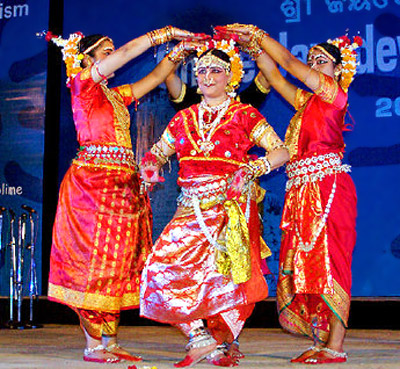
Odissi presents a fine synthesiss of lasya (feminity) and Tandava aspects of the Indian Classical Dance. The dancer very efficiently changes from one to the other according to the need of the expressional number, rhythmic syllables and abhinaya. The dance numbers are either in Sanskrit or Orissi and the music is a combination of Hindustani and Carnatic classical styles. The performance and enjoyment of Odissi dance recital, so tender and vigorous, intensely erotic and devotional, moving in sculpturesque poses, is an unique experience; a constant source of delight and inspiration.
It transcends all the limits of communication leading to a rich aesthetic and spirtual experience. Like its source, the all time Gita Govinda of Jayadeva, all Odissi performances depict the stories of Lord Krishna and these are soft, lyrical classical dances, including the ambience of Orissa and the philosophy of its most popular deity, Lord Jagannath, whose temple is in Puri.
The performance of the Odissi dancers is given here as follows:
1. Rangamancha-Pravesh refers to the entry on to the stage with floral offering. Rangabhumi Pranam is the salutation to the stage and the earth, and is the first concept or idea. Ishtadeva Vandana is an obeisance made to the dancers favourite deity. Trikhandi-Pranam refers to the salutations made to the gods, guru and the audience, thus concluding the item with "Anjali-hasta" - a gesture of greetings and devotion.
2. Bhumipranama: The beginning of an Odissi/Orissi dance recital is with the Bhumipranama, an obeisance to the chosen deity. It is also known as Mangalacharan, which is an offering made at the beginning of the programme, either in the praise of Lord Ganesha, Lord Jagannatha or Adishakti. The introductory piece is a fine example of short but sweet piece of pure and expressional dance and it commences with the invocation to Gods and salutation. A line of poetry is set to music and it is performed with a combination of pure dance steps and mime, expressing the meaning through the gestures. It is said that the performance of this item ensures success of the recital.
3. Batu: This item follows the Bhumipranama and it is a pure dance item mentioned in the Abhinaya Chandrika. It is derived from the influence of the tantric worship of Balukeshwar Bhairav, an aspect of Lord Shiva. It is a difficult item as it introduces the full gamut of nritta techinique. Beginning with a Chauka position in a slow temp, it gradully moves to intricate movements, which is from Charis to Bhangis to Khandis or Arasas.
4. Batu Nritya: This is followed by an invocatory piece dedicated to a deity chosen by the dancer her called as the Ishata Devata Vandana and it is nritya consisting of short pure dance steps as well as the abhinaya on the verse. The dancer usually chooses a shloka (verse) from Sanskrit or Oriya Poetry.
 5. Pallavi: Then follows the Pallavi, which corresponds, to the Jatiswaram, usually from the Gita Govinda, underlining the passionate love of Krishna for Radha. It is for the first time in this item that a melody is introduced, which the dancer illustrates through her hand movements. The dancer executes movements that follow the sound patterns of the swaras in the raga. It is executed in a very slow tempo, but it may also be executed in a medium or faster tempo, thus being an elaboration of both dance and music.
6. Gitabhinaya: Gitabhinaya comes next, involving enactment of lyrics. The expressional number is a very evocative item full of fine sculpturesque stances, scintillating footwork and a variety of dance patterns demanding a great command and technique on the part of the dancer. It is also known as Sa-abhinaya nritta. These are abhinaya pieces where in the songs are generally well known compositions of poets like Jayadeva, Upendrabhajadev or Banmali Das.
7. Tarajan or Moksha: An Odissi recital ends with a Tarajan or a Moksha, which is a pure dance number, parallel to Tillana in Bharatnatyam. Here, the dance and the dancer become one, culminating into an all-inclusive awareness, a fathomless deep consiousness where all thoughts are dissolved and fused into perfect harmony and equilibrium. It consists of pure dance as well as an abhinaya section, which generally comprises compositions of Hindi poets like Tulsidas and others. An Odissi dancer has to act particular sequences while performing the dance and he/she must have a good concept of acting as well. This is particularly important when it comes to facial expressions.