Dalkhai is one of the most popular folk dances of Western Orissa. It is known as Dalkhai because in the beginning and end of every stanza the word is used as an address to a girlfriend. In Oriya language, the term Dalkhai means `lady love`.
Style of Dalkhai Dance
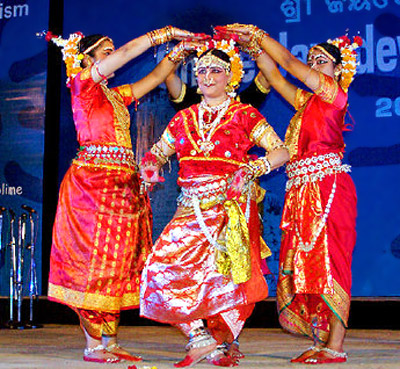
Dalkhai dance is usually performed by young unmarried women. It portrays the famous love story of Radha-Krishna, the episodes from Ramayana and Mahabaharata, the description of natural scenery through the lyrics of songs. The girls sing the Dalkhai song at the start of a performance and then start dancing. Men join them as drummers and musicians. During the performance, one gets to hear `` Dalkahi Bo" repeatedly. Through this additive the male dancers address their girlfriends.
An orchestra of folk music that includes a number of instruments known as Dhol, Nisan and Tamki accompanies the dance. Nisan is a typically giant drum, which is made up of iron case, and Tamki is a tiny one-sided drum played by two sticks. Sometimes, a one-sided drum named Tasa and Mahuri are also played for music. However, the Dhol player controls the tempo of the dance through its beats, by dancing in front of the girls.
At the time of dancing on the rhythms of the Dhol, the performers place their legs close together and bend both the knees. In some other movements, they move in a forward and backward direction in a half-sitting position. Sometimes, as the dance proceeds further they make concentric circles in clock-wise and anti-clock-wise direction.
The Dalkhai dance has several forms that are equally popular, some of them are known as Mayalajada, Rasarkeli, Gunji kuta, Jamudali, Banki, Jhulki, Sainladi etc. As per the style, theme and performance, Dalkhai is basically a secular form of performance.
Costumes of Dalkhai Dance
Dalkhai dancers generally dress themselves with colourful printed Sambalpuri Sari. They also wear a scarf on the shoulders holding the ends below in both the hands. To complete the look, all the dancers adorn themselves with various traditional jewelleries like necklace, bangles etc. Dalkhai dance is quite vigorous and is performed for long hours.
Communities Famous for Dalkhai Dance
The young women of Binjhal, Kuda, Mirdha, and Sama communities mostly participate in this dance form. Dancers from some other tribal communities of Sambalpur, Bolangir, Sundargarh and Dhenkanal districts also show equal enthusiasm in Dalkhai.
Dalkhai dance is performed at Dalkhai festival, Dusserah and other festivals like Bhaijauntia, Phangun Puni and Nuakhai.