Introduction
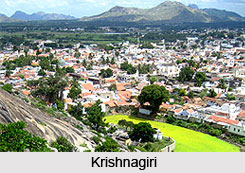 This is the place, which was carved out of Dharmapuri district and regarded as the 30th district of Tamil Nadu. The name `krishnagiri` is derived from `Krishna` that means `black` and `giri` means `hill`. This district is gifted with black granite hillocks and thus named as `krishnagiri`.
There is another saying which gives the idea of naming the district and this can be mentioned as in earlier days the region came under the rule of Krishna Deva Raya and hence it might have been named after this king.
The four boundary of Krishnagiri district can be mentioned as it is bounded by Vellore and Thiruvannamalai districts in the East, Karnataka state in the west, Andhra Pradesh in the North and Dharmapuri District in the south.
The total geographical area of the district is 5143 Sq. Kms. This district is elevated from 300m to 1400m above the mean sea level. It is located between 11º 12`N to 12º 49`N Latitude, 77º 27`E to 78º 38`E Longitude. Eastern part of the district is hot while Western part has a contrasting cold climate.
The average rainfall is 830 mm per annum. The summer season can be experienced from March- June. July-November is Rainy Season and between December-February winter season is there. Three languages namely Tamil, Telugu and Kannada are spoken mainly here in this district. Major religions are Hindu, Islam and Christianity. All the people live with full integration and harmony. The people of different languages as well as cast and creed live here with full confidence.
The total population of the district is 15,46,700. Out of which 7,95,718 are males and 7,50,982 are females. Density of the population per sq. km is 301. Sex ratio of this district is 944/1000. The literacy rate is 58.11%.
The tribal folk named `Irular` live in the forest of Denkanikottai. These people are skilled in tree climbing, honey collection and protecting themselves from wild animals as well.
People of different casts and creed live in this Krishnagiri District. People from Kashmir, Maharashtra, Karnataka and Andhra have settled in this District as well. Hence this district can be truly called as a Cosmopolitan society. Ancient Art & Culture is preserved and maintained by inhabitants. The major entertainments for the people living here can be mentioned as `Street Play` or theru koothu and `Sevai Attam`.
Agriculture in Krishnagiri
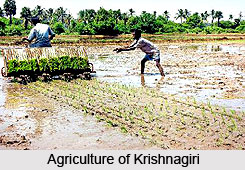
The important crops of Krishnagiri District can be named as Paddy, Maize, Ragi, Banana, Sugarcane, Cotton, Tamarind, Coconut, Mango, Groundnut, Vegetables and Flowers. The district is mainly agrabian,i.e. high scopes for agri business is available here. Since 1973 AD Regional Agricultural Research Center of Tamil Nadu Agricultural University is functioning efficiently at Paiyur in Kaveripattinam union. This center is functioning in 18.5 hec. of land. It helps the agricultural labourer to develop and adopt the modern technique of cultivation. It has developed hybrid seeds by research, which yields more tonnage and good quality as well.
Paddy is cultivated in the area of 20,687 Hec, ragi is cultivated in the area of 48,944 Hec, sugarcane is cultivated in 4,078 Hec while pulses and other minor crops are cultivated in 48,749 Hec and 11,937 Hec respectively.
Horticulture in Krishnagiri
 The land of Krishnagiri District is more suitable for cultivation of Horticulture crops. Other Plantation crops, medicinal plants, Fruits, Vegetables, Spices, and flowers are grown well by way of its moderate climate, high altitude and fertility of the soil. Horticultural crops are cultivated in the area of 38,248 Hec. Fruits are cultivated in the area of 32,162 Hec, vegetables are cultivated in the area of 9,773 Hec whereas spices and flowers are cultivated in the area of 4,398 Hec and 1,115 Hec respectively.
Sericulture in Krishnagiri
In Krishnagiri District at about 5069 acres of land is under mulberry cultivation. This has the employment opportunity for about 24,345 persons at the rate of 5 per acre as well. Training in Mulberry farming, Rearing Silk Worms is done through a large network of Govt. Departmental Institutions of Sericulture such as Silk quality development farms, Govt. Sericulture training center, Govt. Sericulture Farm, Base seedlings (grain age) development farms, Govt. Bi-voltine grain age centers, Govt. Cocoon markets, Silk Reeling Unit, Silk Twisting unit, Technical support and service center for rearing silk worm, etc. With all these above-mentioned facilities sericulture industry has good scope in this district.
Natural resources in Krishnagiri
Krishnagiri is abundant with natural resources having 2,024 Sq. Kms of forest. This forest-covered area gives a refreshing look to the district. This can also be regarded as the unique feature of the district. The hill ranges of this district are called by the name `Melagiri`. The major type of forest that are seen predominant here are the Tropical, Deciduous forests, thorny shrubs and bamboo forest. The Denkanikottai region is always covered by dense forest. The other region contains shrubs, hills and hillocks with bushes. People enjoy the beauty of forest very much.
Flora and fauna of Krishnagiri
The major wild animals that are found in this district are mainly Elephants, Sambar, Spotted Deer, Gaur, Wild boar and Panther etc. The forest area of Denkanikottai Taluk forms the prime elephant habitat with lot of bamboos. This area also constitutes the Cauvery elephant reserve. This elephant reserve is constituted over and area of about 450 Sq. Kms. The bird population is also attractive at this place with beautiful bird like Paradise flycatcher. Big lakes in Anchetti and Hosur areas also attract large number of migratory birds like Painted storks, Teals etc. Apart from these birds and mammals, there are variety of butterflies, giant spiders etc. Some of these are going to be endangered list and also can be extinct in near future. Migratory butterflies also come to this place. Kodakkarai shoal forest in Denkanikottai Taluk is known for large scale migratory butterflies during a particular season then one can observe thousands of migratory butterflies passing through this forest.
The district is a paradise for natural lovers. The flora includes variety of timber trees like Rose wood, Teak, Sandal etc. There are hundreds of medicinal herbs, minor forest plants like nelli, kadukkai, cheekai, pungam etc. are also very much present. Another important tree namely pungam trees are found in abundance in this forest. That is the reason pungam oil is extracted from this seeds of this tress, which is a non-pollutant Bio-fuel.
The Vast forest resource that is present in this district is really a unique feature. In these forests many important trees are present and these can be mentioned as Sandal, Teak, Rose Wood and Bamboo. The timber from these trees has great demand for structural works, e.g. House construction, Shipbuilding, Paper and pulp manufacture, Pencil and Ply wood Industry, etc. Growing nursery for herbs and medicinal plants, extraction sandal wood oil for perfumery is regarded as the major contribution for the industrial growth in Krishnagiri District. The forest products like bamboo rice and honey supplement the food for tribal and in this way the forest benefits them.
Minerals and industries in Krishnagiri
The district Krishnagiri is very famous for its minerals and industries. "Paradise" is the most popular multi coloured granite available in Krishnagiri. Black granite is available in Hosur and Denkanikottai. In Hosur surroundings many granite-processing units are present. At these units making slabs of granite, finishing and decorating the granite beautifully is done very successfully. The multi coloured paradise slabs are being exported to America, England, Australia and some other European countries in large quantities. This industry is flourishing with the uninterrupted supply of electricity and availability of raw material and land at cheaper rates. A variety of quartz stones from Denkanikottai and White metal called Limestone from Uthangarai are mined at this place.
Rivers in Krishnagiri
The main rivers that flow across the district are Kaveri and South Pennar Kaveri. This enters the district from South West in Denkanikottai taluk and exists in South West direction. It forms a waterfall at Hogenakkal and joins Mettur Dam. South Pennar originates in Nandidurg of Karnataka and flows through Hosur, Krishnagiri and Uthangari Taluks as well. Vanniyar and Markanda rivers join this South Pennar.
Krishnagiri Reservoir
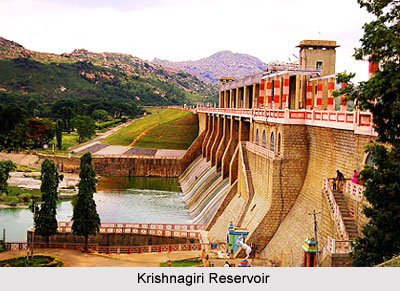 The Krishnagiri reservoir was build upstream of Sathanur Dam. Although the reservoir encompasses the same area as the dam, it is much shallower. The native species found in this reservoir were preserved but hardly used for commercial reasons. The species include P. sarana, Ompok bimaculatus, M. vittatus, Notopterus sp., murrels and others. A year after, species like catla, rohu, mrigal, C. cirrhosa, L. fimbriatus, C. carpio, C. reba, L. calbasu, Oreochromis mossambicus, L. kontius, P. dubius and Rhinomugil corsula are also stocked. The breeding rate was high initially, but now it has become moderate. This was a healthy drift, indicating the achievement of proper preservation. The present yield of the reservoir is only about 10.6 kg/ha/year with a range of 8.61 to 13.00 kg every hectare.
Temples of Krishnagiri District
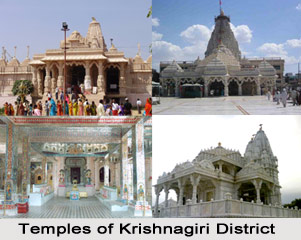 Temples of Krishnagiri district are mostly constructed on higher elevations and boasts unique sculptures, related to its past. Krishnagiri district is the holy land of wise scholars, men of valour and courage, blessed with the green valleys, hills and hillocks and inhabited by people known for pioneering in farming techniques. `Krishna` refers to `black` and `giri` refers to `hill`. This district is gifted with black granite hillocks and named as "krishnagiri". Most of the temples of Krishnagiri district are in close relation with the history of this land. The region came under the rule of Krishna Deva Raya and hence the district might have been named after this king.
Krishnagiri district is bounded by Vellore and Thiruvannamalai districts in the East, Karnataka state in the west, State of Andhra Pradesh in the North Dharmapuri District in the south. Arulmigu `Penneswarar Moorthy` temple, ` Lakshminarayana` temple of Krishnagiri, `Chandra choodeswarar` temple of Hosur, `Kundeeswarar` temple of Chinna Kothur, `Balamurugan` temple of Jagadevi, `Angalamman` temple of Kaveripattinam, `Bettaraya Swamy` Temple of Denkanikottai are few major temples of Krishnagiri district.
The particular features of the temples of Krishnagiri district are its heights and exquisite carvings. The sculptures and stone inscription of the temples of Krishnagiri district, disclose that these temples were built during Chola and Vijaya Nagar periods. The Holy Dharga of Denkanikottai, The Sacred Heart Church of Krishnagiri are also other popular sacred places in this district.
Krishnagiri Fort : 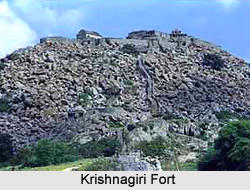 Krishnagiri Fort is an important fort located in Krishnagiri district in the Indian state of Tamil Nadu. Krishnagiri is a municipal center and the headquarters of Krishnagiri District. It is believed to be one of the strongest forts in the state that is presently maintained and protected by the Archaeological Survey of India. The Krishnagiri Fort was constructed by King Krishnadevaraya of the Vijayanagar Empire. It is for this reason that the town and the fort have been named as Krishnagiri. The word Krishna has been taken from the king`s name and Giri means hill.
The Krishnagiri fort along with the surrounding areas was earlier known as baramahal. It was then presented to Jagadevarayan by the Vijayanagar for his display of courage and valour in the battles he fought. Jagadevarayan made Jagadevi his capital. Later in the 17th century Bijapur Sultanate captured the fort and baramahal. It was then given to Shahaji, father of Shivaji as jagir. He made Bengaluru his headquarters and became the ruler of this area. Later when Shahji died his younger son Vyankoji (Ekoji) became the ruler. Again in the 1670s the fort was captured by Chatrapati Shivaji from his younger brother Vyankoji during one of his expeditions to Deccan.
Again in the 18th century Krishnagiri fort and baramahal was captured by Hyder Ali as per the instructions given to him by Chikka Devaraja Wodeyar, the king of Mysore. Much later he severed ties with the King of Mysore and retained these areas. He rules the surrounding places and made Srirangapatna his own capital. During the First Mysore War a long blockade took place here that resulted in surrendering the fort to the British in the year 1768. The fort was attacked by the British troops under Lt. Col. Maxwell in November 1791. This event took place during the third Mysore War that resulted in 50 British casualties. As all the officers and the members in the troop were either wounded or dead they had to move back. The fort remained under the possession of Tipu Sultan until the Treaty of Srirangapatna in 1792. Later it went into the hands of the British. Presently the fort is maintained by the Archaeological Survey of India and serves as a tourist spot.
Tourism of Krishnagiri
The names of some of the tourist`s places are given below. There are some more monuments, temples and memorials present in the district.
Krishnagiri Dam : 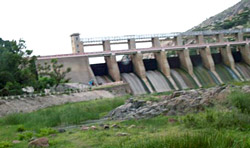 Krishnagiri dam is situated at the distance of 7 Kms from Krishnagiri. It is located between Dharmapuri and Krishnagiri. This dam helped in the irrigation of thousands of acres of land around Krishnagiri, which is in turn proved as very helpful for the district. This is a famous tourist spot too. This dam is flooded with tourists during the weekends.
Thali the little England : This place is located at about 25 Km from Hosur. It is at the border of Tamil Nadu adjoining Karnataka. This is situated in the land of valleys and cliffs. The climate is very cool and pleasant here. It experiences cold and cloudy weather resembling England. Hence this place is named in such a manner `Little England` since British Regime. The area is covered by a number of hills. The climate is cool all through the year. The taluk headquarters is Denkanikottai. In 1530 AD Palayakarar builds the fort at Denkanikottai. The fort is destroyed during war with Hyder Ali and Tippu Sultan. There is a temple for Venugopala Swami. Car festival is held during the month of May every year. Thousands of devotees visit during this festival.
Hanumanthathirtham : This place is situated on the bank of Pennaiyar at a distance of 10 Km from Uthangarai and traditionally associated with Tirthamalai. The water at this place is considered sacred and during the Tamil month of Aadi i.e. July-August people come in a large number to visit the spot.
Kelevarapalli Reservoir Project (KPRP) : This project was constructed completely in 1995 AD. It is situated at a distance of 10 Kms from Hosur. It is only 8 Kms away from Karnataka state. This has become a picnic spot for citizens of Hosur area. Tourists from adjoining state often visit this place on holidays. They enjoy at this place and thus visited by lot of tourists every year.
Arulmigu Maragathambigai Chandra Choodeswara temple : 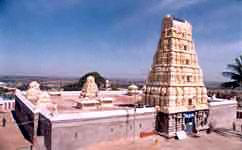 This temple is located in Hosur on NH-7. Most of the pilgrims that visit the place are mainly from Karnataka state. This temple stands on a hillock. Beside this temple there is a children`s park and an observatory is setup by the tourism department. A guesthouse is also functioning under the control of Tamil Nadu tourism. This is also placed nearby.
Government museum : One museum is present at this place, which is mainly known, for traditional culture, Art and Architecture, Heritage and Historical Background. This is actually a blessing in disguise. The main thought behind it is to spread the traditional and heritage, culture and art of Tamil Nadu and Krishnagiri District in particular. This museum is functioning since 1993 AD. This is situated on Gandhi Salai in Krishnagiri. Historical monuments are preserved and exhibited here at this place. It is not only a place of tourism but also a center of education. This museum collects the monuments, Classifies and preserves them to conduct research on its historical worthiness.
Monuments and memorials: There are some historical monuments and memorials present in this district. The name of these are given below:
Rajaji Memorial -Thorapalli : The great leader Rajaji`s house was converted as a memorial. The Tamil Nadu Government does this. The house is in Thorapalli where Rajaji was born. Now this is regarded as a memorial. It is located at the distance of 10 Km from Hosur near Onnalvadi. Some of his belongings and a photo gallery depicting his various walks of life are displayed here at this place.
Rayakottah :
Rayakottah is a hill fort. This is situated at a distance of 30 Km from Hosur. This marks the border of the Palghat plateau. It was a strategic place for the British even after the Mysore wars, where their troops were stationed till 1861. The walls of the fort are more or less intact. The fort is a protected monument as of now.