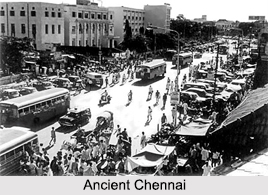
 Chennai is an Indian city in the south of the country. It was formerly known as Madras. At present, it is the capital of Tamil Nadu. It happens to be India"s fifth largest city. It is situated on the Coromandel coast of Bay of Bengal. The estimated population of the city is 8.9 million that was calculated back in the year 2014. It is a 400 year old city which is also the 31st largest metropolitan area in the world. The city of Chennai is known to boast a long history beginning right from ancient rulers through British rule to its evolution during the late 20th century. Additionally, it has a long broad and rich history within the records of empires of South India.
Ancient History of Chennai
Madras or Chennai was situated in the Tondaimandalam province, an area that lies amongst the Ponnaiyar River of Cuddalore and Penna River of Nellore. Kancheepuram was the capital of the province. There is a belief that the Brahmins and Mudaliar of Tamil caste tend to be the inhabitants of Madras. Madras as a name was derived from the word "Madrasan" which was a fisherman head who resided in the coastal area of Madras. Although, "Puliyur Kottam" is the 2000 year old original name of Madras. The modern city of Chennai arose from the invasion of British but prior to that, it was ruled by the Todaiman Ilam Tiraiyan during the 2nd century. He was a Chola representative of the historic family at Kanchipuram.
Rule under the Chola Dynasty
The region subsequent to Ilam Tiraiyan was ruled by Ilam Killi, the Chola prince. The tondaimandalam occupation of Chola was put to an end by the Andhra Satavahana incursion starting from north under their own king Pulumayi II. Chieftains were appointed to look after Kanchipuram under the empire of Satavahana in beginning of the 3rd century.
Rule under the Pallava Dynasty
The beginning of the 3rd century had marked the rule of the Pallavas till the end of 9th century. The only exception was few decades when it was ruled by the Kalabhras. Under Aditya I, the Pallavas were defeated by the Cholas. The Pandyas under the Jatavarman Sundara Pandyan came to power and they put an end to the Chola supremacy in the year 1264.
Rule under the Vijayanagara Dynasty
The present Chennai was an English settlement that started in 1644. It was known as Fort St. George. The region back then was known to be a part of the Vijayanagar Empire, headquartered in Chandgiri. The rulers of Vijayanagar who controlled the area had appointed chiefans known as Nayaks. The Nayaks are known to rule different regions of province independently. Demarla Venkatadri, a Nayak of Padma Velama was in charge of the region. When the English East Indian Company had arrived he was in charge of the same.
European History of Chennai
The East India Company along with the DemarlaVenkatadri Nayakar had travelled to the palace of Chandragiri on 20th August in the year 1639. The purpose was to meet King Peda Venkata Raya in order to obtain permission for a small trip to the Coromandel coast from Chandragiri to build warehouse and a factory for their trading activities. From the domain of Demarla Venkatadri Nayak, on 22nd August in the same year, a piece of land amongst the Cooum River at a point where it enters the sea and Egmor River was given or to be precise granted to the East India Company.
The Fort St. George was founded on this waste land and a fortified settlement of British merchants, colonial settler and factory workers was formed. The English expanded their colony upon this settlement to include new British settlements, other European communities, and several native villages. One of the villages was named Mudhirasa Pattanam. Upon this and honour of the later village, the British had named the entire colony and combined the Madras city.
Invasion of the Portuguese
The modern day Chennai had originated as a colonial city. Initially, the growth was tied closely to the importance of the place as a trading center and artificial harbor. The Portuguese had made its arrival in the year 1522 and built a port known as Sao Tome. Later to that, the region was into the hand of the Dutch.
Invasion of the Dutch
In the year of 1612, the Dutch established themselves to the north of Pulicat. During the 17th century, it was decided by the East India Company to build a factory on the east coast. The village of Armagon was chosen for this, which was 35 miles north from Pulicat. However, the Calico cloth from local area was in high demand but it was of poor quality and not suitable for export in Europe. It was soon realized by the English that the port of Armagon was not suitable for any trade purposes. A new voyage was started by Francis Day, the Chief of the Armagon Factory in the year 1637 down the coast for choosing a site for new settlement. This is how the English has made its settlement in Madras.
 Invasion of the British
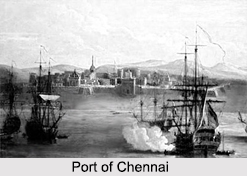
Dutch and Portuguese traders were living in the San Thome area when British first entered the city of Madras in 1639. The British East India Company built a fort and trading post in 1639–40. At that time, the weaving of cotton fabrics was a local industry, and the English recruited local weavers to settle near the fort. By 1652 the factory of Fort St. George was recognized as a presidency of the British Empire.
In 1746, Fort St George and Madras were captured by the French under General La Bourdonnais, the then Governor of Mauritius. The French plundered substantial wealth from the village of Chepauk and Blacktown which prospered due to the growth of trade. The British regained control in 1749 through the Treaty of Aix-la-Chapelle. The city subsequently faced attacks from French, Danes and then from Hyder Ali, sultan of Mysore and his son Tipu Sultan which ended following the Treaty of Madras with Mysore.
Madras was the capital of the Madras Presidency and was a wholly British controlled system of English East India Company. This is when The Madras Chamber of Commerce was founded in 1836 by Fredrick Adam, Governor of the Madras Presidency and the Madras Trades Association was established in 1856, to grant entry to the old colonial families involved in textile trade into the British and Indian financial trade system.
Madras during World War I
The city of Madras, presently Chennai, had also faced the brunt of the First World War when it was shelled by the German light cruiser SMS Emden, resulting in 5 civilian deaths injuring 26 others. Even, the crew of a merchant ship was also destroyed by the Germans that same night in Madras.
After the independence of India in the year 1947, the city was formed as the legislative and administrative capital of the Madras state which was renamed as Tamil Nadu in the year 1968 with Madras as its capital city. The City of Madras again changed its official name to Chennai in 1996. At present, the modern day Chennai is a large commercial, cultural and industrial center. It is also known as the automobile capital of India with forty per cent of the automobile industry having their base. It is one of the major manufacturing center and most of the vehicles of nation are produced here. The UNESCO had included Chennai in its creative city networks because of the rich cultural heritage of Chennai.