 The day of Purnima is a full moon day that marks the division in each month between the two lunar fortnights. The Shukla or bright Paksha is the fortnight before and the Krishna Paksha which is synonymous to dark, is the fortnight after Purnima. A full moon occurs when the Sun and the Moon appear separated by 180 degree. This lunar day of Purnima is considered to be auspicious for new beginnings. There are certain Purnima Tithis, which are celebrated for special occasions, listed below are some of the festivals that are celebrated during Purnima.
Magha Purnima: Also known as Maghi Purnima, it is the day of full moon that occurs during the Hindu calendar month of Magh, which corresponds with the months of January and February. During this time period, the auspicious Kumbh Mela is held every twelve years, and the Magha Mela is held on an annual basis at the confluences of three rivers or Triveni Sangam all around north India, such as in cities like Allahabad or Prayag.
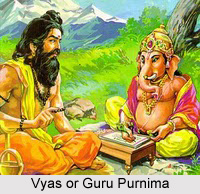
Guru Purnima: The Day of full moon or Purnima in the Month of Ashadh (June and July) is traditionally celebrated by Hindus as Guru Purnima. This day is also known as Vyas Purnima as the day is celebrated in remembrance and veneration to sage Ved Vyas. Vyas was the Adi or original Guru, who wrote the Mahabharata and 18 Puranas and classified the Vedas into 4, namely Rig Veda, Sama Veda, Yajur Veda and Atharva Veda. On this day the spiritual Gurus are worshipped and remembered by their disciples.
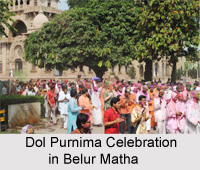
 Dol Purnima: The auspicious festival of Holi is observed as Dol Purnima in West Bengal, which is the full moon day in the month of Falguna (February and March). The festival is dedicated to Lord Krishna. On this day, an image of Lord Krishna is beautifully decorated with coloured powders and flowers and is taken out in a procession, in a swinging palanquin. The palanquin is also decorated with flowers, leaves, coloured clothes and papers. The procession proceeds forward with music and blaring of conch shells. Dol Purnima is more significant to the Bengalis as it is the birthday of saint Chaitanya. He was a great Vaishnava saint, who popularized the `Namsankirtana` of Srikrishna among the common people.
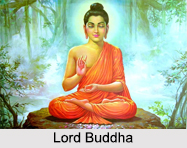
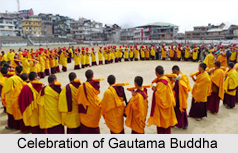
Buddha Purnima: Buddha Purnima is the most sacred day according to the Buddhist calendar. This is the most celebrated festival among the Buddhists, which is observed with great enthusiasm. Buddha Purnima has special significance because on this day Lord Buddha was born, attained enlightenment and attained Nirvana after eighty years of life seeing 1000 full moon days. This strange threefold coincidence gives Buddha Purnima its unique significance. This auspicious day is celebrated on the month of Vaisakha (April and May).
 The Buddhists celebrate this day with prayer meets, group meditation, processions, worshipping the statue of Buddha, symposium and sermons on the life of Gautama Buddha, religious discourses, continuous recitation of Buddhist scriptures etc. The Mahabodhi Temple in Bodh Gaya, Bihar wears a festive look and is decorated with colourful flags and flowers. Also people from all over the world gather at Bodhgaya, where Buddha attained enlightenment, to celebrate the festival of Buddha Purnima or Vesak, Buddha Jayanti.
Vat Purnima: Celebrated by the married woman in the western Indian states of Gujarat, Maharashtra, Goa and some regions of Uttar Pradesh, the Vat Purnima or the Vat Savitri is celebrated during the month of Jyeshtha (May and June). It is a three day long festival where a married woman marks her love for her husband by tying a ceremonial thread around a banyan tree. The celebration is based on the legend of Savitri and Satyavan as narrated in the epic Mahabharata.
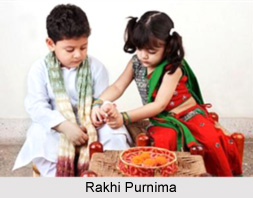 Rakhi Purnima: This is the Purnima celebrated in the month of Shravana (July and August), when sisters tie a sacred thread or Rakhi on their brother`s wrist. Before doing so, they worship the God and then perform Aarati. Putting Tilak on the forehead of the brothers is also an important part of the whole ritual. Rakhi is tied with the prayer of long lives for brothers and the gesture reveals love and close bonding between the siblings.
Sharad Purnima: Celebrated at the end of the month of Ashvin (September and October), Sharad Purnima also known as Kojagiri Purnima is a harvest festival. The month of Ashvin marks the end of the monsoon season and during this time the festivals are celebrated. Kojagari Purnima concerns the observance of the Kojagara Vrata; people perform this Vrata under the moonlight after fasting for the day. Goddess Lakshmi is worshipped during this festival.
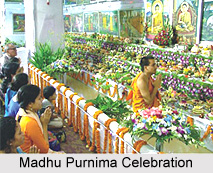 Madhu Purnima: The festival of Madhu Purnima, which means honey-filled full moon, is observed between the Buddhists in India and Bangladesh, especially in Chittagong area. This Purnima is celebrated in the month of Vadra (August and September). It is believed that Buddha pacified his two groups of disciples who were arguing between themselves. One elephant and one monkey fed Buddha that day. The elephant brought fruits while the monkey brought honey. The monkey was so happy with the thought that Buddha took food from his hand that he was leaping from one tree to another to express his boundless joy. But finally the monkey fell from the tree and died. However he got Nirvana by the grace of Gautama Buddha. Madhu Purnima is celebrated as a joyous day of unity and charity. The Buddhists bring honey to the monasteries on the day of Madhu Purnima.
Kartik Purnima: A Hindu, Sikh and Jain cultural festival, Kartik Purnima is celebrated on the 15th lunar day of the month of Kartik (November and December). It is also known as Tripuri Purnima and Tripurari Purnima. It is sometimes called Deva-Diwali or Deva-Deepawali - the festival of lights of the Gods. Karthikai Deepam is a related festival celebrated in South India and Sri Lanka on a different date.