


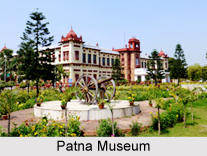
 Patna Museum is an Indian state museum. More specifically, this museum is located in Buddha Marg in Patna, the capital city of Bihar. This museum is archaeological and natural. Its director is JPN Singh. In 2007, this museum had record visitors of about 800,119. Locally, this museum is also known by the name of Jadu Ghar. The museum represents the architectural style of the Mughals and Rajputs. Patna Museum is an Indian state museum. More specifically, this museum is located in Buddha Marg in Patna, the capital city of Bihar. This museum is archaeological and natural. Its director is JPN Singh. In 2007, this museum had record visitors of about 800,119. Locally, this museum is also known by the name of Jadu Ghar. The museum represents the architectural style of the Mughals and Rajputs.
History of Patna Museum After the separation of Bihar and Bengal, the idea of building a museum in Patna surfaced in 1912. The Britishers felt the need to preserve and display the historical artefacts found in the vicinity of Patna and had thus built a museum called the Patna Museum in 1917. The Patna Museum started functioning in 1915 from the commissioner's bungalow, on the campus of A N Sinha Institute. The present building of the Patna Museum was built on Patna-Gaya road (presently Buddha Marg) in 1925. This two storied building was designed by Rai Bahadur Bishnu Swarup. Until the construction of the present building, the artefacts were temporarily shifted from its initial location to the new rooms of Patna High Court building. The construction of this building was completed in 1928. In 1929, the artefacts were again shifted to the present building. The then Governor of Bihar and Orissa, Sir Hugh Lansdown Stephenson opened the new Patna Museum. The Patna Museum received the status of being the first museum of Bihar and Orissa Province. Archaeological Objects Preserved in Patna Museum A variety of archaeological objects are preserved in the Patna Museum. The collection of Patna Museum comprises of sculptures, art objects, paintings, textiles, thankas, coins, instruments, bronze images and terracotta images by Hindu and Buddhist artists. The world-famous Didarganj Yakshi statue is considered to be the museum's most prized collection. It was discovered on the Ganges riverbank in 1917. Visitors may also find the rare collection of the museum captivating. This rare collection comprises of the paintings belonging to the British-period. These paintings depict day-to-day life. Of historic relevance is also the fine collection related to the first President of India, Dr. Rajendra Prasad and the First World War cannon. A casket housed in the museum is also worth mentioning. It contains the sacred ashes (relics) of Gautama Buddha, which was unearthed in 1958 at the Relic Stupa of Vaishali by archaeologist A. S. Altekar. This museum is also preserving the fossil of a tree. This fossil is known to be more than 200 million years old. Development of Patna Museum As the exhibit of this museum increased, the necessity of expanding the museum was felt. As a result, in the beginning of November 2009, a project commenced to build a replacement museum in Patna. This building would be used to display a larger collection of up to 20,000 objects. Nearby Attractions of Patna Museum Some of the nearby attractions of the Patna Museum are Folk Art Museum, Peral Cinema, Alankar Palace, Mahavir Temple, Buddha Smriti Udyan, Golghar and Veena Cinema. Visiting Information The Patna Museum has good transport availability. The nearest airport to Patna Museum is Lok Nayak Jaya Prakash Narayan Airport, which is situated at a distance of about 5 km from Patna Museum. The nearest railway station to Patna Museum is Patna Junction Train Station, which is situated at a distance of about 1 km from Patna Museum. Patna Museum is located near Kotwali Thana in Buddha Marg in Patna. Related Articles: Indian State Museums Museums of Bihar Nalanda Archaeological Museum Bihar Museum Sarnath Museum Bhagalpur Museum Channdradhai Museum Chapra Sangrahalaya Gaya Museum Nardah Museum |
| |||



Patna Museum
| Established in the year 1917, Patna Museum is one of the famous museums of India. |
| ||||||||||||||||||||||||||||

