


 Hinduism is a religion that does not have a single founder, a specific theological system, a single system of morality, or a central religious organization. The definition of Hinduism entails that it is a term which denotes the religions of the majority of people in India. Hinduism is world’s third largest religion after Christianity and Islam. Hinduism is the dominant religion in India, where Hindus form about 84 per cent of the total population. As per the scholars, the actual term ‘Hindu’ first occurred as a Persian geographical term for the people who lived beyond the Indus River. Hinduism is the amalgamation of thousands of different religious groups that have evolved in India since 1500 BC. Hinduism is a religion that does not have a single founder, a specific theological system, a single system of morality, or a central religious organization. The definition of Hinduism entails that it is a term which denotes the religions of the majority of people in India. Hinduism is world’s third largest religion after Christianity and Islam. Hinduism is the dominant religion in India, where Hindus form about 84 per cent of the total population. As per the scholars, the actual term ‘Hindu’ first occurred as a Persian geographical term for the people who lived beyond the Indus River. Hinduism is the amalgamation of thousands of different religious groups that have evolved in India since 1500 BC.
Origin of Hinduism Origin of Hinduism is quite ancient and dates back to 5,000 or more years. This is the reason why it is regarded as the oldest organized religion of the world. Certain elements of Hinduism such as baths which serve a ritualistic purpose and phallic symbols, such as the Shiva lingam and the Swastika signs were found in the Bronze Age. Eventually ‘Hindu’ became virtually equivalent to an ‘Indian’ who was not a Muslim, Sikh, Jain or Christian, thereby encompassing a range of religious beliefs and practices. The ‘ism’ was added to ‘Hindu’ in around 830 to denote the culture and religion of the high-caste Brahmins in contrast to other religions. Moreover, the term was soon appropriated by Indians themselves in the context of establishing a national identity opposed to colonialism, though the term ‘Hindu’ was used in Sanskrit and Bengali hagiographic texts in contrast to ‘Yavana’ or Muslim, as early as the 16th century. Features of Hinduism Hinduism is often characterized as being polytheistic, and while it is true that innumerable deities are the objects of worship, many Hindus will regard these as an aspect or manifestation of sacred power. Devotion to deities mediated through icons and holy persons provides refuge in times of crisis and even final liberation from action and the cycle of reincarnation. The transcendent is also revealed in sacred literature, called the Vedas and in codes of ritual, social and ethical behaviour, called Dharma, which that literature reveals. Hindu is a creed which is renowned for its universality. In this oldest Indian religion, the main aim is to achieve a communication between God and man. Most forms of Hinduism are therefore henotheistic in religion. 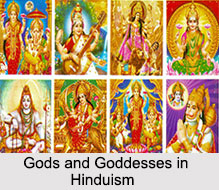 Gods and Goddesses in Hinduism Gods and Goddesses in Hinduism
The concept of Ishvara in Hinduism, recognises a single deity, and views other Gods and Goddesses as manifestations of that supreme God. According to the Hindu philosophy, the Supreme Being contains both masculine and feminine traits. Hindu Gods are regarded heavenly beings who can descend to earth as limitless incarnations. The feminine aspect of the divine is special form of the divine mother - Shakti. Indian Goddesses also emerged as Brahma’s ensemble, such as Goddess Saraswati, the goddess of learning. Goddess Lakshmi, the goddess of wealth appeared, Parvati or Goddess Durga is the ultimate source of strength. Development of Hinduism Hinduism as a global religion with a distinct identity has arisen since the 19th century, clue in large part to the reformers. Hinduism which they have promoted is the kind which is best known in the West, largely due to its use of English as a medium of communication, its adoption of Christian elements and its outward-looking perspective. While Hindu revivalism is of vital importance in the development of Hinduism as a world religion, the influence of these traditions of Sanskrit learning and popular ritual upon it has been minimal; the Hindu renaissance has had a tendency to play down the differences between theological traditions and to relegate ritual to a 'popular' level. Through the work of Ram Mohan Roy and later of Swami Vivekananda and his followers, Hinduism has become a world religion which has had a deep impact both on India and on the West at all cultural levels. 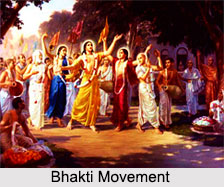 Bhakti Movement in Hinduism Bhakti Movement in Hinduism
Bhakti Movement is a Hindu religious movement and the main spiritual practice is to show loving devotion to God or Bhakti. The devotion is directed towards a particular form of God, such as Lord Shiva, Lord Vishnu, Murugan or Shakti. Bhakti movement started in southern India and spread northwards. Hindu religious leaders have shaped the religion and gave Hinduism a new aspect. These spiritual leaders have renounced inwardly ego-consciousness and worldliness for the superior treasure of God realization and spirituality. Ramakrishna Paramhansa as well as Adi Sankaracharya can be regarded as religious leaders. Religious Texts in Hinduism Indian myths refer to a wider aspect such as Indian epic poetry that includes the Mahabharata and the Ramayana. In addition to that Indian mythology also refers to Vedic Mythology, Hindu Mythology and Buddhist Mythology. Hindu mythology forms the large body of Indian mythology. Hindus believe that their lives are staged in the progression to ultimate enlightenment. With the composition of the Puranas a mainstream form of Brahmanical religion developed which expanded and continued into the medieval period. Hindu religious texts namely the Vedas, the Upanishad and the Indian Puranas include enlightened theories of Hinduism. However, there is no single text, which can conclude its philosophy. The Vedas are hymns praising different Gods. The Upanishads are discourses between a guru (spiritual guide) and a 'shishya' (disciple). This kind of Hinduism has been inclusive and has firmly established itself on the world stage, reformulating 'Hinduism' and discovering its ancient origins. |
| |||



Hinduism Religion
| Hinduism is more of a philosophy which is a way of living according to the understanding of the principles of Vedas and Upanishads. |
| ||||||||||||||||||||||||||||

