
yathabhimata dhyanat va yogic sutra delineates the final way in which one can achieve the transcendental meditative state. The sadhaka needs to channelise his attention in one direction that which is pleasurable and enjoyable to him. However, this object must be beneficial to meditation, and not external materialistic desire. According to this sutra, the most satisfying object to meditate upon is one`s own state of being.
Yathabhimata that which is desirable, a selected thing a pleasing thing, according to one`s wish or taste
Dhyanat by meditation
Va or
Or, by meditating on any desired object conducive to steadiness of consciousness.
The ultimate method is to choose an object beneficial to meditation, not one which is externally pleasing, but auspicious and spiritually enriching. By practising this simple method of one-pointed attention, the sadhaka gradually develops the act of contemplation. Later, when a degree of mental stability is reached, he will be able to meditate on any object at his own willpower.
The perfect performance of an asana is pleasing, and through it too, one can gain quietude.
On the face of it this sutra is simple - it describes meditation on an agreeable object. It is deeper, hidden, and the meaning is harder to apprehend. The most `pleasing` object of meditation is in fact one`s very existence, the core of the being. Patanjali advises followers to trace the seed of that core, the living spirit that interpenetrates everything from the most infinitesimal particle to the infinitely greatest. This is the most difficult subject to meditate upon.
Yathabhimata dhyanat va
This is the thirty-ninth yogic sutra which is contained in the Patanjali Yoga Sutras.
Recently updated articles in Yoga
Khanda Manda Yoga
Khanda Manda Yoga is a difficult form of yoga where the Yogi cuts off his own arms and legs with a sharp cleaver, that is axe-like knife, and throws t...
Kaivalya Pada
Kaivalya Pada, the fourth chapter of Patanjali Yoga Sutra denotes an absolute, indivisible state of existence of the Yogi. The Kaivalya Pada is someti...
Vibhuti Pada
Vibhuti is the Sanskrit term for “power” or “manifestation.” In this third chapter, Patanjali introduces the final three limbs of Aṣṭanga Yoga, collec...

Sadhana Pada
Sadhana Pada in Patanjali Yoga Sutra denotes the idea of practicing yoga that leads to spiritual illumination. Sadhana, the Sanskrit term for “practic...
Samadhi Pada
Samadhi Pada is the first chapter of Patanjali Yoga Sutra. In this chapter, the author explains the essence of yoga, the nature of samadhi, and the me...
Related articles in Yoga
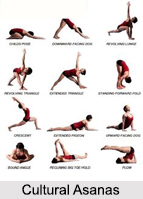
Cultural Asanas
Cultural Asanas refer to the daily physical exercise postures that train the body and mind in Yoga Practice.
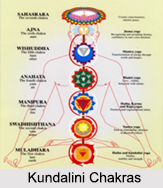
Kundalini Chakras
Kundalini Chakras are psychic energy centres or vortices, which connect between our psychic and physical energy systems.
Patanjali Yoga Sutras
Patanjali’s Yoga Sutras presents a foundational guide to the philosophy and practice of yoga. Through concise aphorisms, it outlines the nature of the...
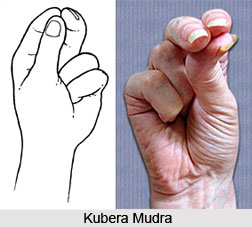
Kubera Mudra
Kubera Mudra, a form of Hatha Yoga, leads to the elevation of mental peace and physical relief by proper practice and cleanses frontal sinuses.