Kapila - Ancient Sage
Kapila was a wise ancient sage, who was the proponent of Sankhya philosophy. Kapila is famous for his teachings as a process of liberation known as Bhakti Yoga.

Share this Article:

About Kapila

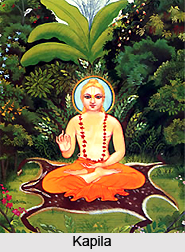
Kapila, Indian PhilosopherIn the Puranas, Kapila is described as an incarnation of Lord Vishnu. Kapila is a historical sage, who lived in the Indian subcontinent sometime around 500 BC. In Bhagavad Gita he is mentioned by Lord Krishna as perfect being. In Bhagavata Purana, Kardama Muni and devahuti are mentioned as his parents. After his father Kardama Muni left home, Kapila instructed her mother Devahuti in the philosophy of Yoga and the process of worshipping Lord Vishnu, enabling her to achieve both Moksha or liberation and pure love of God.

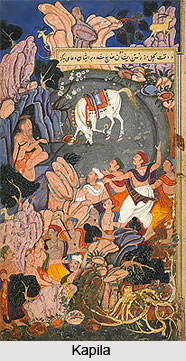
Kapila is associated with the story of Makar Sankranti and bringing down River Ganga from heaven. King Sagar of Ayodhya, who was the ancestor of Lord Rama, was also involved in that story. King Sagara had performed the sacrifice of Ashwamedha for ninety-nine times. In that sacrifice a horse is released and an army follows it. If any king arrests the horse then a fight occurs and if the battalion on the side of the sacred horse wins, the defeated king had to bow to its owner king. Finally when the horse returns to its own kingdom, it is killed and a grand Yajna is held. When king Sagara performed the Ashwamedha for the hundredth time, Indra, the king of heaven became so jealous that he kidnapped the horse and hid it in the hermitage of Kapila Muni.

The great king Sagara had sixty thousand sons who set in search of the horse and found it in the Ashram of Kapila. They believed Kapila to be the abductor and dishonored him. Kapila cursed the attacker so that they turned into ashes. Anshuman, the great grandson of king Sagara came to Kapila and prayed to him to redeem the souls of his sixty thousand ancestors. Kapila replied that if only Ganges descended from heaven and touched the ashes of the sixty thousand souls, then only they could be redeemed. As a result Bhagiratha brought Ganga to the earth.

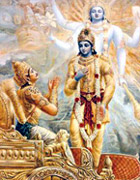
Kapila is prominent in the Bhagavata Purana. In the Bhagavad Gita Kapila is depicted as a yogi hermit with highly developed spiritual powers. Kapila is also mentioned by Lord Krishna in the Bhagavad Gita.

Teachings of Kapila Muni

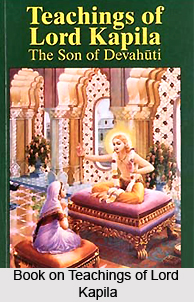
Teachings of Kapila MuniKapila Muni was one of the great philosophers born to the great sage Kardama. His mother Princess Devahuti was a scholarly woman who had discarded all royal pleasures and dwelled in a hermitage. Kapila Muni being the notable son of his parents had published his famous philosophy, the Samkhya during 2800 BC. The chief points of his philosophy were:
(i) He termed his philosophy Samkhya meaning ascertainment of truth. He had explained those in twenty-two concise sayings.
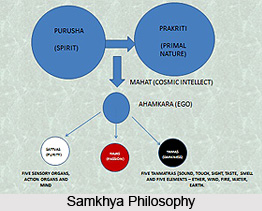
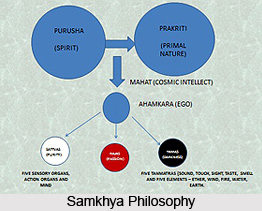
(ii) He mentioned about twenty-five tattvas which includes philosophic truths like nature, soul, intellect, (ego or consciousness), mind, the five grosser elements, the five subtle elements, the five senses of perception, the five organs of action and others.
(iii) His concept of God is transcendental in nature. It is for this reason that his philosophy is often called agnostic or atheistic.
(iv) kapila Muni has devised the theory of evolution.
(v) He has mentioned about the three gunas, i.e. various properties of matter like goodness, passion and darkness. It is for these gunas that the creation has become so diversified.
(vi) He explains that the process of creation is possible through the combination of prakriti and purusha (primordial matter and spirit or soul),
(vii) His theories hold very high position. According to Davies, the philosophy of Kapila is the first recorded system of philosophy in the world.
(viii) Kapila theories were against various Vedic sacrifices and the slaughter of animals. According to his views Vivek (pure wisdom) is the key to nirvana (salvation).
(ix) He mentions about the immortality of the soul; fourteen orders of beings, eight above and five below man; law of karma; intellectual creation and eternity of matter.
(x) He says `tri-tapas` (three miseries) is the cause of all distress. Bodily and mental; natural and extrinsic; divine or supernatural are three types of miseries. He concludes his theory mentioning that man needs to relieved of these miseries hence they should be eradicated from the common man`s lives.

Kapila Muni had preached his philosophies to Asuri and Borhu but it became wide spread because of the efforts of Panchasikha, disciple of Asuri. Panchasikha later elaborated the book of Kapila`s Sankhya in varoius parts. Isvara Krishna during the fifth century AD prepared a karika of it in a new form which is still followed. Kapila`s philosophy was much accepted and even the Vedas, the other philosophies, the Puranas, Buddhism, the Sanskrit epics and other systems were much inspired from it. Pythagoras was the first one who introduced Kapila`s philosophy in East Europe (sixth century BC). Even the latest German philosophy, the principle of Schopenhauer (1819) and Von Hartmann (1869) is fundamentally based on the lines of Kapila Muni`s theory.

Kapila Muni`s was based on pure philosophy which did not have ideas based on God. The Brahmans of Brahmavarta gradually accepted the theories of Kapila Muni while the Aryan kings noted his theories willingly. Soon his theories were established in the court of Janadeva. Even Rishabha Deva, founder of Jainism, followed the views of Kapila.


Worship of Kapila

Worship of Kapila, Agni PuranaLord Agni in the great Purana known by the name Agni Purana has dedicated a chapter to the worship of the cow Kapila. It is believed that Kapila is the one who imparts joy to its worshippers. The description commences saying that Kapila is the abode of all bliss. She has a gentle character and is regarded as a celestial animal. Kapila, is believed to have a good temperament and She has the capacity to impart enjoyment to this world and salvation in the world after death.
Purpose of worshiping Kapila : It has been mentioned in the Purana that Kapila is the daughter of Suravi, who in turn is considered to be the mother of the universe. She grants all boons and gives ambrosia to the Gods. Lord Agni says that worshippers pray to Kapila for all their desires to be granted. People pray to her to take away all sins and inequities from their lives.

Method of worshiping Kapila : The worshipper in the process of worship asks the Kapila cow to stay close always. The worshipper also wishes that he or she may be able to meditate upon the Cow Kapila in a proper manner. As he or she continues the worship of the Cow, morsels of food are also offered during the process.

After having addressed the Cow, the worshippers should deem themselves as identical with Lord Shiva or the supreme blissful one, who is pure, and whose ethereal self is incapable of sin. Then the worshippers should prepare for the worship of Shiva. And the worship of Lord Shiva involves a number of steps and many other deities are worshipped along with Him. An important component of the worship is the uttering of the Mrityunjaya mantra and the performing of Homa ceremony. As the worshippers perform the Homa ceremony they should merge the breath in the fire of Homa after having contemplated the divine essence of Shiva. Then the morsels of food are offered to several Gods and are cast into the oven.

First the oblation is done to the Fire-God, then to Soma. The next oblations follows a fixed pattern like oblation to Vrihaspati, to Prajapati and to all the other Gods and the offerings should be cast into the different quarters of the heaven, starting with the east. After that the worshipper should bid adieu to the oven fire.

The custom then involves worshipping the God of Virtue or the God of Piety towards the right side of the heaven and towards the left, the spirit of impiety is offered obeisance. Worship of Lord Varuna or the fire-god of the sea, and the worship of Lord Ganesha are important parts of worshipping Kapila.

One by one all the other Gods and Goddesses who preside over every element of the household should be worshipped by the worshipper with absolute dedication. And only after pleasing all the deities of the house, the worshipper can have food.


Share this Article:

More Articles in Indian Philosophy


Classical Indian Philosophy
Classical Indian Philosophy contains many analyses, rational principles and explanations. The Vedas have been considered as the first and the oldest scriptural texts of the Classical Indian Philosophy.
Ajivika Philosophy
Ajivika philosophy is different from the mainstream religion
Gunas - Hindu Philosophy
Guna in Hindu Philosophy in its philosophical sense refers to the constituent quality. The whole universe is guided by the three gunas, which are basically attitudes, qualities found in human being.
Bodhisattvas - Hindu Philosophy
Bodhisattva is a concept in Hindu philosophy and the Buddhist philosophy and refers to someone who is committed to attain Enlightenment.
Religion and Philosophy in Later Vedic Period
Religion and Philosophy in later Vedic period did see minute growth. However, rituals and traditions were religiously followed.
Theory of inference in Nyaya philosophy
Nyaya theory of inference is divided into five steps.
Theory for God in Nyaya philosophy
The Naiyayikas tried to establish the existence of God through logic.
Religious Influence on Indian Philosophy
Religious influence on Indian philosophy has been almost enigmatic, making it complimentary in perspective.
Morality and Ethics in Jain philosophy
Jains follow a fivefold path of morality and ethical purity, by which one can reach moksha.
Indian Philosophy In The Vedic Period
Indian Philosophy in the Vedic Period was primarily based on the concepts of nature worship.
Metaphysics in Jain philosophy
Metaphysics in Jain philosophy revolves heavily around the soul and its governing path and final emancipation.
Nether World in Jain Philosophy
Nether World according to Jain Cosmology consists of seven subterranean regions. Of the seven regions the above two regions serve as the abode of heavenly gods and in the rest torture of the souls is undertaken for any kind of misdeed.
Achintya Bheda Abheda Philosophy
Achintya-Bheda-Abheda is a School of Vedanta that represents the philosophy of unimaginable one-ness and difference in relation to the power creation and creator.
Samkhya Philosophy
Samkhya philosophy is one of India’s oldest intellectual traditions, explaining reality through the interplay of Puruṣha (pure consciousness) and Prakrti (primordial nature). By enumerating twenty-five tattvas, it offers a rational path to liberation, emphasizing discernment, self-knowledge, and freedom from suffering through understanding the true nature of the Self.
Jain Cosmology
Jain Cosmolgy presents the universe in the form of a male figure. In the figure various body parts are dedicated to various lokas. For instance the region above the head is said to be the siddha lokas and so on.
Charvaka Philosophy
The Charvaka Philosophy believes that only those things that can be perceived is the ultimate reality.
Indian Philosophy
Indian Philosophy is intense spirituality that emphasises on the attainment of salvation and eternal bliss through a righteous path.
Jain Philosophy
Jain Philosophy is a religion and philosophy originating in ancient India that separates body from the soul completely. The concept of Jain philosophy has the non-violence among the people.
Twelve Nidanas
The twelve nidanas are aimed to understand the root cause of suffering in samsara, guided from ignorance and hankering.
Vedanta Philosophy
Vedanta Philosophy is one of the six orthodox systems. It consists of 555 Sutras and its observation and explanations are based on Samkhya system.