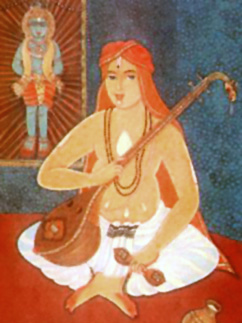
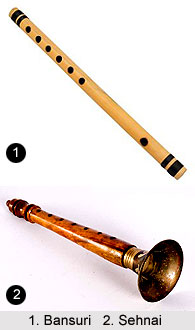
 Wind Instruments in East Indian Folk Music are one of the oldest Indian musical bases known under different names. In the rural areas of the eastern sector of India, benu, bansuri, murall, sahkha, or koubu, shehnai, mahuri, are the names familiar for useful aerophones of a few types. It is known that venu was often used in the olden days. Venu, when played horizontally, reminds the pose of Lord Krishna with venu in his hand.
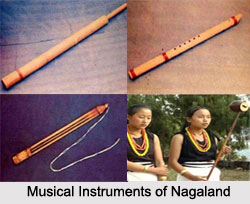
The vertically played bansi is very familiar with all tribes and Adibasis. The variety of bamboo flute (Tripura bansi) is now-a-days claimed to be a peculiar contribution of Tripura because of the fact that peculiar bamboo stems are available in jungles of Indian state of Tripura.
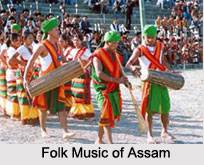
Snake-charmers pipe in the eastern region is of the same type as is found in North India. The development of musical bansi with seven holes of proportionate tune adjustments is rather a later contribution. It appears that flute was never used for accompaniment with songs except at some areas of the western sector among the Austric group of people Mundaris, Santals, etc. In Assam the use of bamboo tubes of varied size may also be observed amongst some tribes. Sankha, kombu and horns of different types have been in use in special ceremonial occasions from the olden days.
Shehnai is an imitated instrument from original Shehnai Surna of the Muslim period and is used in special rituals. Shehnai is based on the usage of two reeds at the mouth fixed on a tube the resonator. The bottom contains a piyala or a cup. In some folk-songs of the western border of Indian state of West Bengal miniature imitation shehnai is observed to be used by Adivasis. But it is a rare feature. Imitation sehnai is played to dhol in rural marriage ceremonies, especially in old East Bengal (Bangladesh).
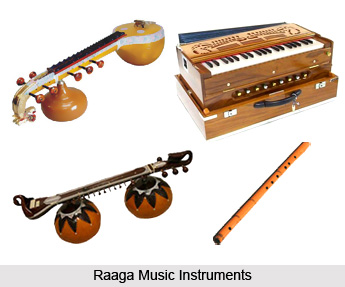
It may be mentioned that harmonium has gained wide popularity in rural areas and it is commonly used in all types of songs. It may also be mentioned that in finished folk music of polished type as presented in phonographic discs, radio or TV programmes now-a-days, flute and dotara are used as the major supporting instruments for musical accompaniment.