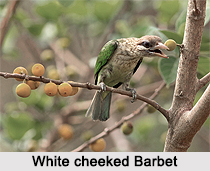
 White-Cheeked Barbet or small Green Barbet is an Indian bird that bears a scientific name "Megalaima viridis" concentrated in the Western Ghats Mountain Range in India and the states like Maharashtra, Pune, Goa and upper part of Konkan coast.
Concentration of White-Cheeked Barbet
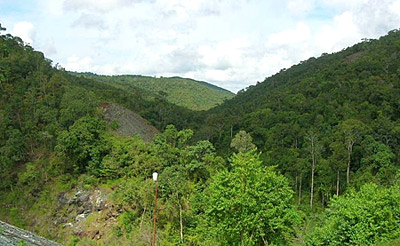
White-Cheeked Barbet is a species of barbet found in southern part of India. It is very similar to the more widespread Brown-Headed Barbet (or large green barbet) (Megalaima zeylanica) but this species has a distinctive supercilium and a broad white cheek stripe below the eye and is endemic to the forest areas of the Western Ghats and adjoining hills.
Structure of White-Cheeked Barbet
White-Cheeked Barbet has an orange eye-ring but the calls are very similar and the two species occur together in some of the drier forests to the east of the Western Ghats Mountain Range in India. Like all other Asian barbets, White-Cheeked Barbets are mainly frugivorous although they may sometimes eat insects and they use their bills to excavate nest cavities in trees.
Breeding Season of White-Cheeked Barbet
White-Cheeked Barbets are green, sit still and perch upright making them difficult to spot. During the breeding season which begins at the start of summer their calls become loud and constant especially in the mornings.
Call of White-Cheeked Barbet
The call of White-Cheeked Barbet is monotonous in nature starting with an explosive trrr is not easily differentiated from that of the brown-headed barbet. During hot afternoons, white-cheeked barbet may also utter a single note unlike the call of collared scops owl or coppersmith barbet. Other harsh calls are produced during aggressive encounters.
Size of White-Cheeked Barbet
The head of White-Cheeked Barbet is brownish streaked with white, sometimes giving it a capped appearance. The bill of white-cheeked barbet is pale pinkish. The length of White-Cheeked Barbet is 165-185mm, head of 51-53mm and tail of 60-67mm. The Size varies from the larger northern birds to the southern ones.
Diet of White-Cheeked Barbet
White-Cheeked Barbets are mostly frugivorous, but will take winged termites and other insects opportunistically. They feed on the fruits of various Ficus species including Ficus benjamina and Ficus mysorensis, and other introduced fruit trees such as Muntingia calabura.
 Distribution of White-Cheeked Barbet
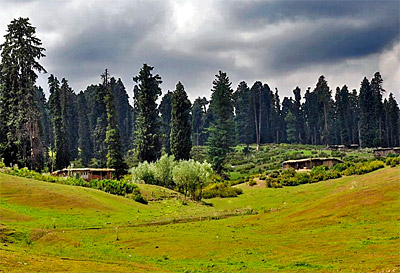
The main distribution range is along the Western Ghats Mountain Range in India south from the Surat Dangs and along the associated hills of southern India into parts of the southern Eastern Ghats mainly in the Shevaroy and Chitteri hills. In some areas such as in the city of Bangalore, it has been suggested that this species may have displaced the Brown-Headed Barbet which was once said to occur there
Behaviour of White-Cheeked Barbet
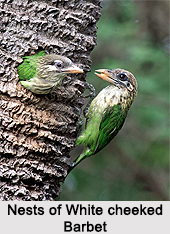
White-Cheeked Barbets are primary cavity nesters, chiseling out the trunk or a vertical branch of tree with a round entry hole.
Breeding of White-Cheeked Barbet
White-Cheeked Barbet breed from December to July, sometimes raising in two broods. Favoured nest trees in urban areas include gulmohur and African tulip (Spathodea campanulata). These nest holes may also be used as roosts. They may reuse the same nest tree each year but often excavate a new entrance hole.