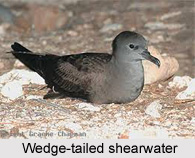
 Wedge-tailed shearwater with a scientific name "Puffinus pacificus" is a medium-large shearwater in the seabird family Procellariidae.
Concentration of Wedge-Tailed Shearwater
Wedge-tailed shearwater is one of the shearwater species that is sometimes referred to as a mutton-bird, like the sooty shearwater of New Zealand and the short-tailed shearwater of Australia. It ranges across from throughout the tropical Pacific and Indian Ocean roughly between latitudes 35 degree North and 35 degree South.
Breeding of Wedge-Tailed Shearwater
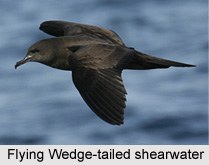
Wedge-tailed shearwater breeds on islands of Japan, on the Islas Revillagigedo, the Hawaiian Islands, the Seychelles and off Eastern and Western Australia. The wedge-tailed shearwater is the largest of the tropical shearwaters. There are two colour morphs of the species, dark and pale; the pale morphs predominate in the North Pacific, the dark morph elsewhere. However, both morphs exist in all populations, and bear no relation to sex or breeding condition. The pale morph has grey-brown plumage on the back, head and upper-wing, and whiter plumage below. The darker morph has the same dark grey-brown plumage over the whole body. The species" common name is derived from the large wedge-shaped tail, which may help the species glide.
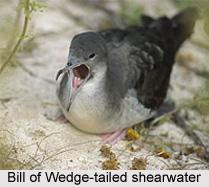
Bill of Wedge-tailed Shearwater
The bill of Wedge-tailed shearwater is dark and legs are salmon pink, with the legs set far back on the body as an adaptation for swimming.
Tail of Wedge-Tailed Shearwater
Wedge-tailed shearwater is related to the pan-Pacific Buller`s shearwater, which differs much in colour pattern, but also has a wedge tail and a thin black bill. They make up the Thyellodroma group, a super species in the large shearwaters of the proposed genus Ardenna.
Diet of Wedge-Tailed Shearwater
 The diet of Wedge-tailed shearwater is 66 percent fish, of which the most commonly taken is goatfish. It was thought that the species mostly took food from surface feeding, observations of feeding wedge-tails suggested that contact-dipping, where birds flying close to the surface snatch prey from the water that was most commonly used in hunting technique.
Settling of Wedge-Tailed Shearwater
Wedge-Tailed Shearwater breeds in colonies on small tropical islands. Breeding seasons vary depending on location, with synchronised breeding seasons more common at higher latitudes. Northern hemisphere birds begin breeding around February, southern hemisphere birds begin around September. Wedge-tailed shearwaters display natal philopatry, returning to their natal colony to begin breeding at the age of four. Chick of wedge-tailed shearwater in burrow, Kilauea Point National Wildlife Refuge