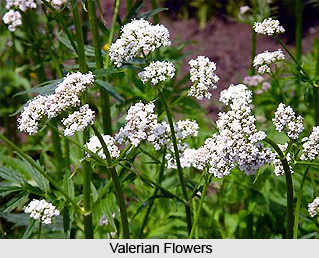
 Valerian is a perpetual herb growing upto 1 metre in height. Its rhizome is thicker than the stem, producing suckers or shoots rising from the ground. The stems are grooved, bushy below and polished above, while its lower leaves are longer than the smaller upper leaves. The plant has small, white flowers in small bunches and small and polished fruits. The rootstalks and roots of the plant make up the drug.
According to some authorities, the name Valerian comes from the Latin word `Valere`, standing for- to be in health, while others believe that it takes its name from an ancient physician, Valerius, who first utilised the herb in medicine.
The herb contains valerianic, formic and acetic acids, in addition to a volatile oil, resin, starch, a glucoside and two alkaloids-chatrine and valerianine.
Methods of usage
Valerian comes to numerous everyday disease usages, like acting as an antispasmodic and stimulant, healing nervous breakdowns, insomnia, and hysteria.
Healing Power and Medicinal Properties of valerian
The leaves should be gathered together in autumn and dried gradually. The antispasmodic and stimulant properties of this plant are well-admired in native medicine and have been delineated in the books of Ayurvedic medicine.
Nervous Disorders cured by valerian
Valerian is an established curative for functional disturbances of the nervous system. It was possibly the most former treatment of neurosis, accompanied by physical diseases with mental symptoms or social maladjustment, particularly in interpersonal relationships.
The herb is especially useful in curing cases of hysteria, ungratified and irritable conditions. The drug induces depressant action on the overall central nervous system. It has derived magnitude in recent years due to its advantageous effects in epilepsy. It is also regarded beneficial in chorea, a condition marked by unremitting unconscious jerks.
Insomnia healed by valerian
The herb is beneficial in the treatment of insomnia. It diminishes excitation, irritation and ache. The fresh juice of the plant can be used as a sedative to hasten sleep.
Methods for Uses and Dosages - The juice of the fresh rhizomes and roots is considered more effectual in the treatment of nervous disorders, because its medicinal properties get diluted on drying. A concoction of valerian is prepared by instilling 30 grams of the herb in half a litre of boiling water. The latter should be had in small quantities, three or four times a day.