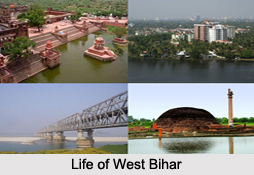
Vaishali is chiefly noted as one of the places where
Gautama Buddha often preached. Numerous references to Vaishali are found in texts pertaining to both
Jainism and
Buddhism, which have preserved much information on Vaishali and the other Mahajanapadas. This place is considered one of the first examples of a republic, in the
Vajjian Confederacy (Vajji) Mahajanapada, around the 6th century BC. It was here in 599 BC the 24th Jain Tirthankara;
Lord Mahavira was born and brought up in Kundalagrama in Vaishali republic, which makes it a pious and auspicious pilgrimage to
Jains community. It is supposed that the town derived its name from King Vishal. The king`s heroic deeds have been mentioned in the Hindu epic
Ramayana. Vaishali was the capital city of the
Licchavi tribe. However according to history,
Pataliputra was the centre of political activity in the
Gangetic plains and Vaishali came into existence as centre of the
Ganga. It was the seat of the Republic of Vajji. Vaishali is credited with being the World`s First Republic to have a duly elected assembly of representatives and efficient administration.
Lord Buddha"s last Varshavas (rainy season) was here and he announced his approaching
Mahaparinirvana (the final departure from the world) just 3 months in advance. Before leaving for
Kushinagar, where he laid his mortal coil, he left his alms-bowl here with the people of Vaishali. Vaishali is also renowned as the home of
Ambapali, a great courtesan who appears in many folktales as well as in
Buddhist literature. Ambapali became a disciple of Gautama Buddha.
Rulers of Vaishali : According to the
Vishnu Purana records 34 Kings of Vaishali. The first king was believed to be Nabhaga, who renounced his throne over a matter of human rights and then declared himself as the free tiller of the soil, king over his own acre. The last among the 34 was
Sumati, who is considered a contemporary of
Dasharatha, father of the
Hindu god,
Rama.
Politics at Vaishali : 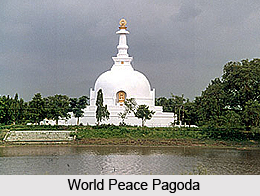
Vaishali consisted of 3 distinct portions viz. Vaishali, Kundagama and Vaniyagama. In the 6th century B.C. the Licchavis emerged as the most important political power. The earliest political fact about them is that they gave one of their daughters in marriage to
Bimbisara of
Magadha. They were also on friendly terms with the
Kosala king Prasenjit and the Mallas. They were defeated by Ajatsatru.
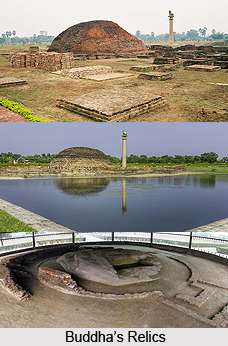
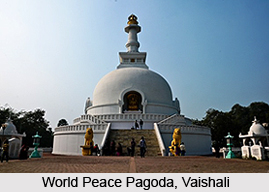
Relics at Vaishali : A kilometre away is Abhishek Pushkarini, the coronation tank. The sacred waters of the tank anointed the elected representatives of Vaishali. Next to it stands the Japanese temple and the Vishwa Shanti Stupa built by the Nipponzan-Myohoji-Daisanga sect, a Japanese new religion. A small number of Sarira found in Vaishali have been enshrined in the foundation and in the chhatra of this stupa. Near the coronation tank is Stupa 1 or the Relic Stupa. Here the Licchavis reverentially encased one of the 8 portions of Buddha`s relics, which they received after his Parinirvana. After his last discourse, Buddha set out for Kushinagar, but the Licchavis kept following him. Buddha gave them his alms bowl but they still refused to return. The Master created an illusion of a river in spate which compelled them to go back. This site can be identified with Deora in modern
Kesaria, where
Ashoka later built a Stupa.
Administration of Vaishali : The history of Vaishali is very important from the administrative point of view. It was an oligarchical republic. Citizenship was confined to the members of the united clans. The governmental authority in Vaishali was vested in a senate which consisted of the head of the resident
Kshatriya clans and was presided over by a King assisted by a Viceroy and a Commander-in-Chief. Each citizen had the right to call himself a Raja, which was regarded as a synonym for Kshatriya. The Sanghas or corporations were united and hence unconquerable. The public hall was known as "Santhagar". They met there to hold religious and political discussions. There was an officer known as "Regulator of Seats". His duty was to see that the members sit in order of seniority. All matters were settled by majority vote. A quorum was fixed for the meeting. The
Nayaka or the Chief Magistrate was elected by the people. He was an executive officer and carried out the decisions of the Assembly. The Vinischay-Mahamatta enquired and examined the accused and his duty was to ascertain the guilt.

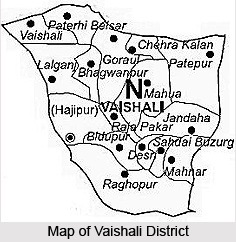 Vaishali is a district in Bihar. It is named after the ancient city of Vaishali of Mithila, which is mentioned in the Mahabharata as well as in Buddhism and Jainism. It is a part of Tirhut division. The district is also home to the Barela Salim Ali Zubba Saheni Wildlife Sanctuary from the year 1997. Vaishali district comprises of three sub-divisions; namely Hajipur, Mahnar and Mahua.
 The district of Vaishali came in to existence on 12/10/1972. Earlier it was the part of old
 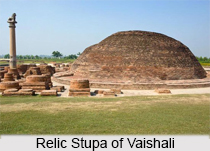 Tourism in Vaishali deals with the ancient relics, Buddhists stupas, ancient monasteries and the World Peace Pagoda (