
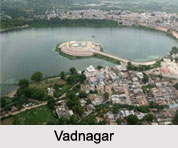
 Vadnagar is considered as the ancient city in west India. It is now a city in Mehsana district in Gujarat. This city in west India has many Hindu temples. In Indian Scripts, this city is named as Anartpur.
Vadnagar
Vadnagar is an oldest city in Mehsana District of Gujarat. This city has many archaeological sites and the temples.
Introduction
Vadnagar is considered as the ancient city in west India. It is now a city in Mehsana district in Gujarat. This city in west India has many Hindu temples. In Indian Scripts, this city is named as Anartpur.Location of Vadnagar
Vadnagar is now a major commercial city located at an average elevation of 143 metres from the sea level.
History of Vadnagar
 History of Vadnagar, in Mehsana district of Gujarat, dates back to more than 2500 years. The place is mentioned as Anartapur in the Hindu epic Mahabharata. It also mentions that the warriors of Anartapur fought in the war of Mahabharata on behalf of both sides and the rivalry among them continued even after the war. Historical facts also suggest that the place served as the earliest capital of Gujarat. However, after the war, the place lost its position as a capital city and the seat of power while a new city Vallabhi became the capital of Gujarat. Vadnagar continued to thrive as a trading city. Archaeological excavations at Vadnagar has proved that the place was a flourishing city around 1st century and was a hub of religious and cultural activities where patronized artists, dancers, musicians and sculptors emerged.
In 2nd century AD, the place came to be known as Ananadapura - `the City of Joy`. It also allured and sheltered various followers of Jainism and Buddhism. Gradually the city started to lose its prosperity due to its capture by the Malvas but continued being the centre of art and culture. From 942 - 1244, Vadnagar came under the rule of Solankis who disposed off the Malvas. The Solankis then built the fort around the town for protection. It was under this rule when the town reached the zenith of its prosperity and witnessed a number of architectural marvels including temples, kunds, residences, wells, torans etc.
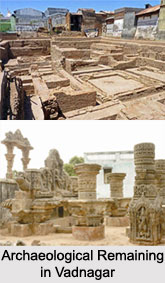
 Vadnagar remained peaceful for the next four centuries after which it was attacked and destroyed by the army of Delhi Sultanate. Even after its devastation, the place managed to regain its prosperity but could maintain it only for a short span of time. In 1726, Vadnagar was attacked by Marathas and was practically burnt down to ashes leaving the place deserted. Again in 1735, it was looted by Khandji Holker and by Daqmaji Gaekwad in 1737 after which the city became completely ruined. Although Vadnagar has been the home to Nagar Brahmins since ages, it could not retain the community for long as they had to flee from the place owing to repeated attacks.
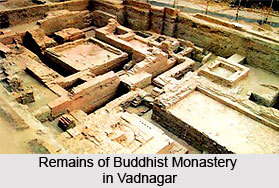
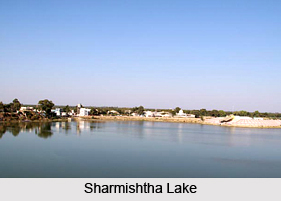
The main town is enclosed within the walls of a fort having six huge gates namely Amarthol, Pithori, Ghaskol, Nadiol, Arjun Bari and Amarthol. The gates were constructed by the Solanki king Kumarpal in 1152 A.D. These gates are intricately designed and represent the excellent craftsmanship of the bygone era. River Kapila flowed in the town in ancient past. A wondrous lake, known as Sharmistha Lake, having a beautiful island amidst it is present in this ancient town. Numerous temples and shrines also stand in Vadnagar, having their origin in remote past. The place was also a significant centre of Buddhism in the past and this fact has been established by the image of Bodhisattva, dating back to 3rd or 4th century AD, which has been found here. Evidences suggest that the image was brought from Mathura for installing in one of the Buddhist monasteries of the town.
Geography of Vadnagar
 The latitudinal and longitudinal limit of Vadnagar is about 23.78 degree north to 72.63 degree east. The average elevation of Vadnagar is about 143 meters (469 feet).
Demography of Vadnagar
According to the Population census in the year 2011, Vadnagar had a population of 25,041. The males constitute 51 percent of the population and females 49 percent. The average literacy rate of Vadnagar is about 65 percent. The male literacy rate is 75 percent, and female literacy is 54 percent. In Vadnagar, 13 percent of the population is under 6 years of age.
Tourism in Vadnagar
 Tourism in Vadnagar, Gujarat, delights the tourists as the town has still retained its distinct old world charm. Old sculptures of the town are impressive and sections of brick and stone fortification can be witnessed at places intervened with six gates namely Arjun Bari, Nadiol, Amarthol, Ghaskol, Pathori and Amarthol. An ancient palace grabs the attention of the tourists in the town. The ancient temples, unique architectural elements, historical associations, crumbling small houses and others make up for an intriguing tourism in Vadnagar.
Sharmishtha Lake : Sharmishtha Lake is an exquisite tourist spot in Vadnagar which presents the water retaining system of the Solanki period. This ancient lake was constructed with the water from the river Kapila which flows from the hills of Aravalli. Ages ago some early settlements emerged on the north eastern shore of the river and they created the lake for retaining water. The formation of the lake led to the substantial increase in the size of the settlement.
Chamatkarpur or the Magical Place :
 About 4000 years ago, Vadnagar was known as Chamatkarpur. The name was rendered to the place for a specific incident in which a king was cured of leprosy after taking bath in the magical waters of Shakti Tirth. As a repayment to the city he revamped it on the shore of the lake by adding temples and palaces. He also named the city as Chamatkarpur. Chamatkarpur served as a prime source of attraction for many scholars as it was the abode of Rishi Yagyavalkya, knower of Vedas.
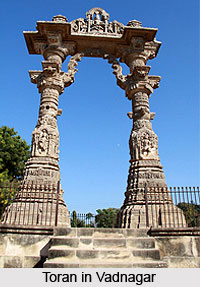
Toranas : Toranas, also known as victory arches, are the magnificent historical monuments of Vadnagar. These arches are located on the western shore of Sharmishtha lake and are believed to have been built by Solanki rulers in the tenth century. These Toranas are structured with red stone and they are more than four-stories tall.
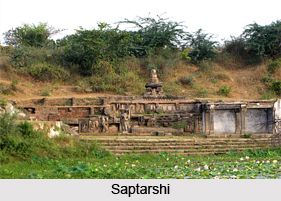
Saptarshi : Saptarshi, situated on the bank of a pond in the eastern part of Sharmishtha Lake, is another tourist spot. This pond receives water from the same Kapila River as Lake Sharmishtha. In ancient times, the place hosted some magnificent buildings and temples. There were stone steps all around the pond. It is also believed to be the place where Yagyavalkya`s ashram existed. Katyayan, his son, was also a great sage. He is known to have established two beautiful shrines called Vastupad and Mahaganapati in Vadnagar.
Amarthol Gate : Amarthol Gate area forms the oldest existing part of Vadnagar. The place has a group of six temples belonging to 10th century AD which stand on spacious platforms. The main shrine which faces the west has been renovated and painted and houses the icon of Goddess Ambaji, called Amther Mata. Smaller shrines stand behind the main one, dedicated to various deities.
Recently updated articles in Cities of India
Places of Interest in Deogarh Uttar Pradesh
A place of historical and archaeological significance, Deogarh is a site with few popular places of interest.
Deoghar in Jharkhand
Deoghar is the divisional headquarters of Santhal Parganas located in Jharkhand and is popular for the famous Baidyanath temple and Shiva Temples.
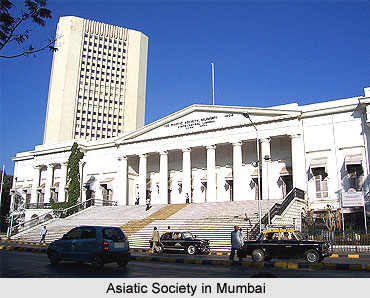
The Asiatic Society of Mumbai
Asiatic Society in Mumbai is the temple of Asian Studies from the time of British rule in India.
Vasco da Gama / Vasco City
Vasco da Gama / Vasco is the biggest city of Goa and is one of the most visited for its perfect amalgamation of business as well as leisure options.
Agriculture of Ladakh
Agriculture in Ladakh is primarily practiced in the short summer season due to its cold desert climate. Farmers grow hardy crops like barley, wheat, p...
Related articles in Cities of India
Holy Cities of North India
Holy Cities of North India are having the rich history of Hinduism and the entire civilization was grown up with the hands of beliefs, rituals and the...
Holy Cities of South India
Holy Cities of South India gives the detailed cultural formation of Dravidians from the early era, which later developed to the world by the Pallavas...
Holy Cities of West India
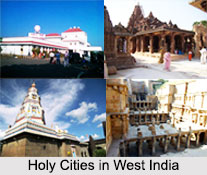
Holy Cities in West India were established by the rulers of Rajputs and the Satvahana Dynasty and the medieval rulers of Junagadh.
Cities of West Uttar Pradesh
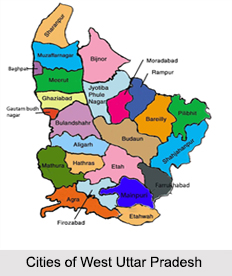
Cities of West Uttar Pradesh include Meerut, Bulandshahr, Ghaziabad, Saharanpur, Muzaffarnagar, Bijnor, Bareilly, Rampur, Agra, Aligarh, Mathura and m...
Port Cities of South India
Port Cities of South India are developed from the early phase of colonial era when the Portuguese and the French traders came to India