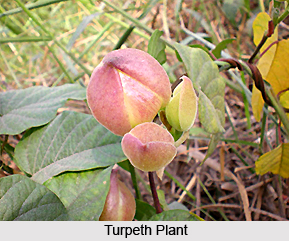
 Turpeth, also known as `Indian jalap`, is a big, solid twisting perpetual herb with sap. It has a many-branched root and quadrangular, winged stems. The leaves are in the shape of an egg and heart. Its white flowers are funnel-shaped, blooming in clusters. Its fruits are round in shape, with normally four seeds in each. The herb is also called as `Indian rhubarb` or Indian jalap, due to its laxative characteristic.
The dried roots of the plant make up the drug. There are diversities of this plant, with either white or black tuberous roots. The roots of the white variety are generally used. The trade name is based on its scientific name.
The bark of the plant contains a glycosidic resin, which has the insoluble glycoside turpethein and two ether soluble glycosides. In addition, it also contains a minor amount of essential oil, glucose and fructose.
Methods of usage
Turpeth can be utilised for several illnesses, like constipation, arthritis, dropsy, gout, jaundice, leprosy, chronic depression and smooth bowel movement.
Healing Power and Medicinal Properties of turpeth
Turpeth has long been in use in India as a purgative, i.e., a drug, which hastens active movement of the bowels, but it was officially acknowledged in the list of Indian Pharmacopoeia only in 1946. Only the dried roots of the white variety with its undamaged bark find its place there.
Chronic Constipation cured by turpeth
Turpeth is used as a laxative. It has virtually similar properties as the true jalap, botanically known as `exogonium purga` and can be used with benefit as its alternative. It is a better-quality herb compared to rhubarb. Its pulverised roots are used as a laxative and to alleviate any acute constipation.
Arthritis cured by turpeth
The drug is advantageous in treating rheumatic and paralytic diseases. A single dosage of 3 to 4 grams should be taken everyday.
Dropsy healed by turpeth
Turpeth is a priceless drug for treating dropsical infections. The tuberous roots in dosages of 2 to 4 grams, blended with chebulic myroblan (harad) are particularly valuable in such disorders.
Gout healed by turpeth
Turpeth is administered in an equivalent manner like dropsical infections for the treatment of gout.
Jaundice cured by turpeth
In Ayurveda, turpeth is regarded one of the two indispensable drugs with which the treatment of jaundice should begin. One or two teaspoon of the grind of each of the two drugs may be dispensed with hot water twice everyday.
Other Diseases healed by turpeth
Turpeth is also efficacious for other diseases like melancholia, leprosy, enlargement of spleen and paralysis. Its effectiveness magnifies threefold when mixed with chebulic myroblan.