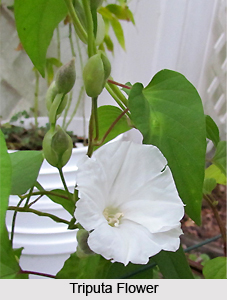
 The plant named Triputa has the botanical name of Operculina turpethum (L.) Silva Manso and it is a common Indian medicinal plant. The English names of the plant are Indian Jalap and Turpeth and it has many names in various native Indian languages, as well. Triputa is actually the Sanskrit name of the plant, while Nisotar is its Hindi name. The plant is known as Trivrit, Trivrt in Sanskrit also and its other Hindi names are Nisoth and Pitohri. In Bengali, the plant is called as Dudhkalmi, Dudiyakalmi, Teori and Tohri; and in Gujarati, it is named as Nahotara, Nashotar. The Marathi names of the plant are Nishottar, Nisottara and Phutkari, while the Tamil speaking people know it as Kumbam, Paganrai, Samaram and Shivadai. The plant is named as Ettategada, Nallategada, Tegada and Tellategada in Telugu.
Triputa is an extensive perennial vascular plant having milky juice and fleshy, branched roots. The stems of the plant are usually angled or narrowly 3-5-winged and the leaves are variable in shape like orbicular, broadly ovate, ovate-lanceolate or lanceolate. The length of the leaves is 5-15 cm and their base is cordate to hastate. The apex is acuminate, acute or obtuse to rounded, with margins entire or more commonly coarsely dentate to shallowly lobed. The upper surfaces of the apex are glabrous or appressed-pilose, and the lower surfaces are pubescent. The flowering part of the plant is axillary, cymosely 1- or few-flowered.
The flowers of Triputa plant are 0.2-1.8 cm long, glabrous or pubescent, with peduncles. The sepals are ovate and 1.5-2.5 cm long and they are also acute or shortly acuminate. The outer of the sepals is pubescent, and the inner is glabrous. The corolla is of white colour with a yellowish base and it is also campanulate to broadly funnel-shaped, having a length of 3-4.5 cm. The corolla is glabrous and has yellowish glandular hairs outside. The fruits of the plant are capsular, depressed-globose, with a length of 1.5 cm, and they are enclosed in the enlarged, papery sepals. The plant`s seeds are dull black, glabrous and 6 mm long. The plant usually flowers between the months of August and October, and fruits from November to December, in central India. The plant is found throughout India in open, disturbed habitats and in woody thickets and hedges to an altitude of about 900 m. It is occasionally grown in gardens as an ornamental plant, as well.
Triputa plant has several medicinal properties and usages and it is known as the main source of the drug known as Trivrit, Turpeth or Indian Jalap. The drug is used in India as a purgative or laxative and it consists of the root bark of Triputa, sometimes mixed with stem pieces. The drug is sold in two forms, white turpeth and black turpeth. The white form of the drug is preferred to the black as a cathartic, and the latter produce drastic purging and cause vomiting, fainting and giddiness. The drug is administered in the form of a powder or in combination with equal quantities of cream of tartar. Apart from making this drug, the root bark of the plant is also used alone or in combination with other drugs in Ayurvedic, Unani and Siddha practice. It is used for treating a variety of ailments and conditions and it is an ingredient of several Ayurvedic preparations used to treat dropsy, as well. The root is also used for treating the diseases like dyspepsia with constipation and flatulence, gout and rheumatism, and other inflammations.