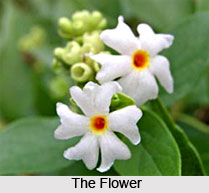
 The `Tree of Sorrow` is usually a thick, tangy wild shrub that is very common in India. The scientists of the world know this as `Nyctanthes Arbor-Trists`. The word `Nyctanthes` is a name built from two Greek words, `nyx` that means "night" and `anthos` means, "flower". The names `Arbor-Trists` and `Tree of Sorrow or Sadness` refer to the night-flowering habit of the plant. It derived from the family of `Verbenaceae`. In Hindi language, the name of this shrub is `Harsinghar`. The Bengali people call it as `Shephalika` or Sheuli`. It has three names in Tamil like `Paghala`, `Pavala Malligai` and `Parijata`. It is named as `Parijathakam` in Malayalam. In English, it is also named as `Night Jasmine` and the `Tree of Sadness`.
Though the tree is a tall one, it becomes a small tree if you cut it back every year. The flowers of the tree are small and creamy-white in colour. You may get surprised by their powerful scent and as they open in the evening and fall early in the morning, they fills the night air with a most pleasing perfume. The flowers of the `Tree of Sorrow` cluster at the ends and along the sides of branchlets. These branchlets spring from the axils of the leaves. A brilliant orange coloured little tube that is not more than a 0.6 cm in length remain surrounded by seven lean petals. These petals do not contain equal lobes and they are a bit rolled and twisted. Each of the little flowers sits in a stalk less cup that is pale green in colour. The cup is sheathed by a tiny leaflet and forms a head up to five flowers. The night flowering plants such like the `Tree of Sorrow` do always cross-pollinated by night flying insects. The principle flowering time of this plant is in the month of December, but it also blooms almost off and on throughout the year.
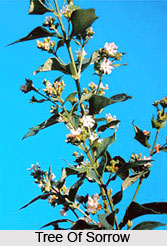 The fruits of the plant are quite large in comparison with the flowers. They are circular and flat. They are also compressed around the edges and reveal the shape of the two seeds within. Usually, the fruits are a rich green in colour at the beginning. With age, they become brown coloured and weak. The leaves of the `Tree of Sorrow` vary in size. The largest one is about 10 by 6.3 cm across. They have a short and strong stalk, a curved base and pointed apex and they grow in the opposite direction. The leaves are dark green in colour on the upper surface and silvery green underneath. A large number of fine hairs are the main reason behind this silver ness. People frequently use these leaves as fine sandpaper for polishing, as they are quite round and hard.
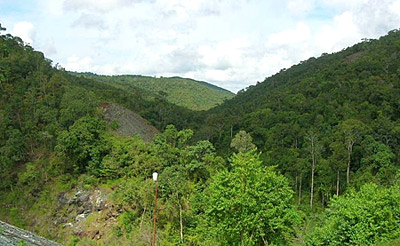
A very rich dye can be obtained from the orange tubes of this shrub. The dye gives the colour used for the robes of Buddhist priests and is also very suitable for `Tussore` silk. The `Tree of Sorrow` can be found in the sub-Himalayan forest and also in other northern and central hills. It is an important component of the undergrowth as it closely covers the ground. It can form humus and the goats eat it very rarely. People can attain an excellent fuel from it and it can also make a batten base for tile or grass thatch roofs. For these useful properties, it is cultivated freely in other parts of India as well. The flowers of the shrub are often used for garlands and placed on biers. It can easily rise from seeds or cuttings during the Rainy season and it is not that selective as to soil. However, a semi-shady spot seems to suit it best.