
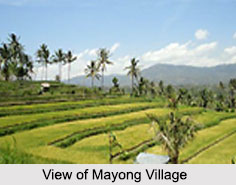
 Mayong, situated in the Morigaon district of the Indian state of Assam, is a village famed as the land of black magic or the black magic capital of India. Also known as Mayang, it is nestled along the banks of River Brahmaputra, at a distance of about 40 kilometers from the city of Guwahati. Previously, Mayong was regarded as the cradle of black magic in India. The village serves as a noted tourist destination owing to its intriguing history.
Mayong
Mayong is a village of Assam reputed as the black magic capital of India. Apart from that, it has several other tourist destinations, which are equally popular like other tourist spots of Assam.
Introduction
Mayong, situated in the Morigaon district of the Indian state of Assam, is a village famed as the land of black magic or the black magic capital of India. Also known as Mayang, it is nestled along the banks of River Brahmaputra, at a distance of about 40 kilometers from the city of Guwahati. Previously, Mayong was regarded as the cradle of black magic in India. The village serves as a noted tourist destination owing to its intriguing history.Etymology of Mayong
It is believed that the village derives its name from the word `Maya` which means illusion and the village is also regarded as the land of illusion. Some say that in Mayong, `Ma` refers to mother Shakti and `Ongo` means part and thus the place refers to the sacred part of goddess Shakti.
History of Mayong
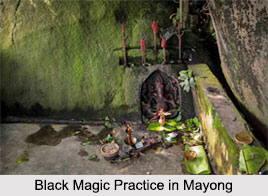 As per the historical records, Mayong was the site of human sacrifices, also known as Narabali, till the early modern period. This practice was in vogue in the village in association with the worship of Shakti. Archaeological excavations carried out in Mayong have furnished swords and many other sharp weapons which have similarity with the tools used in other parts of India for human sacrifices. This resemblance suggests that Mayong had been the centre of human sacrifice during the rule of Ahom dynasty in this region.
Legends of Mayong
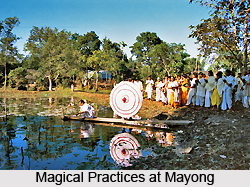 Legends of Mayong, in Assam, have rendered it prominence as the land of black magic and witchcraft. It is believed that during medieval era, the region was a very important centre of magic. People hailing from distant places arrived at this mysterious village to learn the skills of magic and in this way the art propagated through generations. It is also said to be the centre of study of magic in ancient Kamarupa and Pragjyotishpura and owing to its location close to the Kamakhya Temple, it played a crucial role in making Assam a significant centre for tantric studies and practices. A number of legends and folklores also encompass the village.
Legends of Black Magic at Mayong : One of the legends of Mayong relates to a government officer who got transferred to Mayong once. A villager organized a feast and invited the officer and served him scrumptious local delicacies without any chillies. When the officer asked the host for some chillies an astonishing incident occurred in which the chillies arrived skipping on their own. The incident is believed as true by the residents of Mayong. Later it was heard that it startled the officer so much that he left the village with a transfer. It is also believed that the sorcerers or tantrics of the village could summon rains during drought, vanish in thin air and tame tigers.
Another legend says that there was a king of Nepal who brought magic to the valley of Brahmaputra centuries ago. A small kingdom was established by him and Mayong was made its capital. The place gradually emerged as an important place for radical tantricism. Later during the rule of Ahom dynasty, the magical practices were nurtured here by the natives. People of Mayong are deep believers of their magical capabilities and they still use magic and indigenous herbs for solving their day to day problems. It is said that in olden days, the magicians could actually move to wherever they wished with the use of a chant to fly. Legends also say that the invasion of Maans from Myanmar was prevented by the people of Mayong by casting a spell along the boundaries of Mayong and consequently blocking them from arriving.
Legends of Mayong Kingdom : Some believe that the great Mayong kingdom came into existence during the time of a Karbi Youth, Xunyta Singha. According to the folklores, the youth was very handsome and had all the qualities required for being a king. He once encountered a few cowherds and when asked about him he replied that he belonged to Govya Rajya or kingdom, in Malbong of Manipur. He had left his kingdom for some unknown reason. Thus the village recognized him as a king and coronated him, establishing the kingdom. Other records state that Mayong kingdom was included in the Koch dynasty and was a Kochari kingdom and the people of this kingdom are believed to be associated with the son of Bhima and Hidimbeswari of Mahabharata, Ghatotkach.
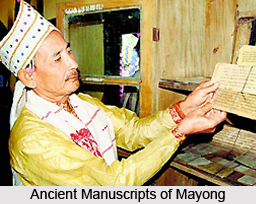
A number of stone sculptures can be spotted in Mayong which narrate its tantric practices. Even in contemporary times, almost every house of the village contains several ancient handwritten manuscripts with varied incantations or mantras. However many of them demolished over time or have been deliberately destroyed by people to prevent the misuse of certain very powerful mantras. Till date there exist some magic practitioners in Mayong who mainly focus on the remedial of common ailments for the people.
Black Magic of Mayong Village
Mayong, the land of occult practices, attracts a number of tourists and caters them the knowledge of black magic. It is often been said that during Mughal Emperor Aurangzeb"s reign, Mughal armies did not fear the armies of Assam, but the power of black magic of the Mayong people. Mayong Black Magic and Witchcraft Museum in Guwahati preserves the knowledge and stuffs of black magic of Mayong people. This museum is listed as one of the ten most unique museums by National Geographic.
Tourism in Mayong
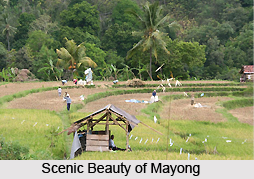 Tourism in Mayong, situated in Assam, encompasses a variety of experiences. Since ancient times, the village has earned the repute of being the land of black magic and occult practices. Black magic is an age old tradition of Mayong and till date many villagers practice them. Apart from exploring this interesting aspect of Mayong, tourists can also cherish the scenic charms of the village. Archaeological excavations have also been carried out at Mayong which gives an opportunity to trace the captivating history and ancient traditions of this land of magic and sorcery.
Nature Tourism in Mayong : Mayong is a great place for nature tourism owing to the presence of Pobitora Wildlife Sanctuary nearby which forms a major attraction of the village. The sanctuary is famed for sheltering the highest density of one horned Rhinoceros across the globe. In addition to Rhinoceros, it also serves as home to other faunal species such as Wild Buffaloes, Wild Boar and others. The vibrant natural beauty of Pobitora wildlife sanctuary can be greatly enjoyed in Elephant Safari and Jeep Safari. Mayong is also surrounded by charming hills and hillocks. River Brahmaputra meanders beautifully towards the western part of the village adding to the picturesque beauty of the place. Spending time along the river bank is very refreshing.
Pilgrimage Tourism in Mayong : Mayong also delights the devotees who arrive in this village for pilgrimage tourism. A number of ancient shrines and temples stand in and around the village. Mayong is also known as the land of Pancha Devata which refers to the five deities of Hindu mythology, Lord Vishnu, Lord Ganesha, Lord Dinesh, Lord Shiva and Goddess Parvati. Some of the prominent temples located in Mayong are Shiva Shrine of Kachashila, Ganesh Temple of Hatimuria, Narashinha Ashram of Hiloikhunda, Kechaikhaiti Shrine of Burha Mayong etc.
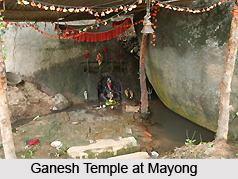
Leisure Tourism in Mayong : Mayong is the site of several archaeological ruins and monuments and tourists interested in exploring the bygone eras of the village. A hilly village situated nearby, called Burha Mayong, shelters a huge stone inscription which dates back to several hundred years. The inscription has a length of 3.85 metres and is credited to be the longest stone inscription of Asia. A majestic stone image of Shiva-Parvati along with that of Lord Ganesha belonging to 12th century can also be located there. Other archaeological findings of Mayong include two stone images of Shiva-Parvati (of about 9th century) at Shiva Shrine of Kachashila Hill, one king sized stone image of Lord Ganesha (10th Century) at Ganesha Temple of Hatimuris village, one stone image of Shiv-Parvati and one of Lord Ganesha (of about 10th century) at Chanaka village and many others. Many other artefacts have also been furnished here such as terracotta images, varied earthen vessels, Shiva Lingams, Yonipeeths, whet-stones, lotus circles, stone-bullets, stone-exes etc. Many of these artefacts have been preserved at Mayong village Museum and Research Centre. Apart from these, exploring the enchanting practices of black magic is also very alluring at Mayong.
Recently updated articles in Villages in India
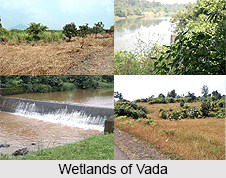
Vada, Village in Maharashtra
Vada is a village in Palghar district in Maharashtra. It is referred as one of the most industrialised estates in Palghar district.
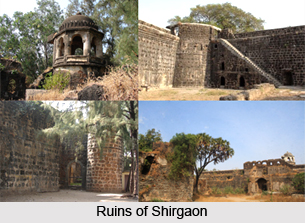
Shirgaon, Palghar District, Maharashtra
Shirgaon is a village in Maharashtra that allures tourists for its beaches and is a famous tourist destination.
Shirgaon, Ratnagiri District, Maharashtra
Shirgaon is a place in Maharashtra dotted with numerous temples dedicated to Gods and Goddess.
Naya, Village in West Bengal
Located in West Bengal, Naya is the village of picture makers called Potuas who have preserved this ancient art since years. The village also hosts th...
Baragaon in Nalanda District
The village of Baragaon is in the Nalanda district of Bihar.
Related articles in Villages in India
Art as Occupation in Indian Villages
Art as occupation in Indian villages involve various types of arts which have evolved into contemporary art products. It has existed since ancient age...

Villages of Kharia Tribe
Villages of Kharia Tribe consists of Umra, Jhikirma, Jamadohar, Katukona, Palkot, Gumla, Sisai, Simdega Basia and others, located in the state of Jhar...
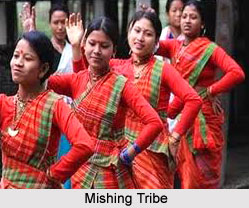
Villages of Mishing Tribe
Villages of Mishing Tribe engage in traditional forms of arts and crafts with each house possessing one local traditional loom. The village provides a...
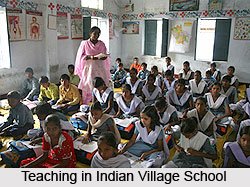
Teaching in Indian Village Schools
Teaching in Indian village schools has always been a respectable profession.