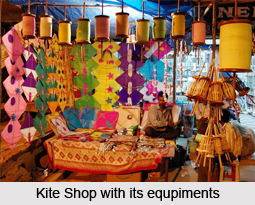
 Tools for kite flying in India involve the various objects with the aide of which kites are flown in the country, and consist of a strong anchor system which is attached to the kites while they are sent flying in the sky.
Line System in Kite Flying in India
A `line` system effectively eases the process of flying kites. Certain single-line kites utilize `tails` which are placed at the end of the kites, to help them glide smoothly through the air, with their noses pointing towards the wind direction.
Use of Spinsocks and Spinners
Spinsocks and spinners are connected to the flying line of kites for enhancing the visual appeal of the flying artefacts, while some wind socks spin beautifully, like turbines, along with the kites. Ideally, the spinsocks and spinners should be at least 50 feet or much more in length.
Modern Kite Materials
About two or four lines are employed in most of the modern kites, in order to control the kites delicately. An additional line is attached to traction kites with the help of which kites are de-powered. They were also quite useful in disentangling kites particularly during emergencies. Various kinds of materials are used to create the line for flying kites like Dacron, hemp, cotton, dyneema, rayon, silk, polyester, linen, kevlon, `manjha` and ultra-high-molecular-weight polythelene.
Essentialities of Kite Flying
The Dacron or Polyethylene terephthalate is a great matter which is moisture and water resistant and hence utilized as a plastic material for kite lines while dyneema is an extremely light-weight gel possessing quite low gravity used in making kite lines.
Manjha in Kite Flying in India
Manjha is the string of the kite which is created from cotton threads coated with a mixture of fine powdered glass, `maida` flour, `vajram` or industrial adhesive, abrasive white and black colour and so on. This material is mainly employed to assist the flying of `fighter kites` in India, Nepal, Bangladesh, Pakistan, Afghanistan and Chile.
Designs in Kite Flying in India
The designs of Kite often emulate flying insects, birds, and other beasts, both real and mythical. The larger kites have clever hinges and latches allow the kite to be disassembled and compactly folded for storage or transport. Cheaper mass-produced kites are often made from printed polyester rather than silk.
Tails in Kite
Tails are used for some single-line kite designs to keep the kite`s nose pointing into the wind.
Related Articles
Traditional Sports in India
Kite flying in India
Tools for Kite Flying
Silk