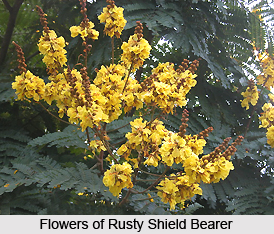
 Being another proud member of the famous `Leguminosae` family, the `Rusty Shield Bearer` tree is named as `Peltophorum Pterocarpum` in science. The sub family of this beautiful tree is `Cceslapinieae`. The name `Peltophorum` came from a Greek word that means, "shield bearing" in reference to the shape of the pods. This tree is not very much common to the Hindi and Bengali speaking people. In Telugu language, the name of the tree is `Kondachinta`. The tree is now widely planted in India.
If someone gives a good look to an avenue of `Rusty Shield Bearers` in the month of April, the onlooker will be astonished to see the extraordinary beauty of these wonderful trees as they are in full bloom at that time. There is no certain flowering season for all the trees as it varies from one to another, but whenever the season starts, it stays for quite a long period. When one tree achieves its full bloom, another may be in its bud stage only. Even such a sight can be found as well that one half of the tree is in flower for some weeks, while the other half has just began, and when the second half becomes gold coloured with its full bloom, the first half will be bearing its fruits. The tree has another minor flowering period from the month of September till the end of the year and some occasional trees can bear a few odd blooms throughout the year.
The `Rusty Shield Bearer` is a tall and straight tree that often reaches the height of 24 m. It has a smooth and grey bark and the crown is quite spreading. It is solid and looks dark when in full leaf. By the end of the month of February, the straight and pyramidal flower sprays are in bud. The numerous green and brown coloured branchlets of the tree are clustered with silky, rust-red balls. After that, at the base, two or three buds of each branchlet open into five petalled flowers. The yellow, wrinkled and twisted copper-red sepals curl back from the slim and rust bases of the petals. The stamens are bulging and bear some bright orange anthers. These pretty scented blossoms last for a very short period and fall down from their calices when they were still fresh. For this characteristic they carpet the ground with gold regularly. The huge copper pods normally develop in abundance and are very much prominent. They can be compared with the prominence of the flowers during the months of December and January, when most of the leaves fall. The pods remain in the trees almost till the next Spring and at that time they become black and fragile.
The trees practically become bare just before the new, bright leaves sprout and this conversion in the space of a few days is one of the most favourite annual pleasures of all the tree-lovers. After one or two weeks, the fresh and gentle green changes and transforms into a much deeper colour. Though the timber of the tree is light and cannot be endured, people use this to make furniture.