 Being named as `Quisqualis Indica` in science, the `Rangoon Creeper` has an odd behaviour. The name `Quisqualis` means `which` or `what` and it was given to this plant by a Dutch botanist named `Rumphius` as he was astonished at the odd behaviour of the species. This shrub derived from the family of `Combrefaceae`. In India, the Tamil people call it as `Iranganmalli`.
The life of the `Rangoon Creeper` is quite normal apart from the strange characteristic in its early growth. The peculiarity is that when a new plant grows for the first six months, it is an erect shrub. After that it soon becomes stouter and stronger than the original stem. Sometimes it can climb the neighbouring trees to a considerable height and becomes a large, woody creeper. It does not twist or stick by means of stems, as do many creepers. This charming shrub is originated from Burma and Malaysian Archipelago. It thrives very well in most parts of India and people cultivate it in their gardens quite commonly. The fresh green leaves of the shrub set off the clusters of pendent pink colour and also the white blossoms. The delicious perfume of the blossoms enhances the attractive appearance. The leaves are oblong and pointed. They are opposite to each other and they are normally from 2.5 to 10 cm in length. They also have some deep veins and they are slightly downy.
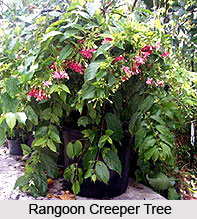 The pink buds grow erect when they are small, but when the slim and lime-green coloured stalks extend to several inches, they droop and open. These long stalks are actually the calices that are in the form of slim tubes. They are divided into five segments. Between these segments, five oval shaped petals are inserted and they form a pink star. On their first opening, the flowers of the `Rangoon Creeper` are white or off- white and part pink in colour. By the course of time, they become completely pink and darken by a long way before they dry up. They appear from the month of March till May and again after the Rainy season. In some parts of India it blooms continuously. There is an all-white variety of the shrub. The plant can rise easily from layers, cuttings or root divisions and if it gets very rich soil, it can grow almost out of control.
It will be a wise move if you cut it back sometimes in the dry season. The black fruit of the `Rangoon Creeper` is soft and pointed. They are dry and contain five wings. They are usually about 2.5 cm in length. You can produce a bitter liquid from the pulped, unripe fruit and use it as vermifuges. The fruit can be eaten after they become matured, but only after moderating. An excessive eating of the fruits can quickly cause nausea and hiccupping. The leaves are also edible and they bear a warm, pungent taste like radishes.