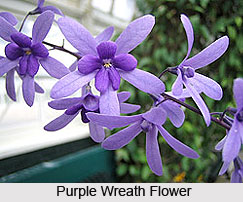
 The shrub that has a sharp contrast between the delicate flowers and the harsh crisp leaves is called as the `Purple Wreath`. The scientific name of this shrub is `Petrea Volubilis`. The name `Petrea` was given to honor the name of Lord Petre, who became famous for his wonderful collection of exotic plants in the 18th Century. The word `Volubilis` means, "twining". This is a member of the `Verbenaceae` family. It is named as `Kudirai Valuppu` in Tamil and in English; it is also called as the `Queen`s Wreath`.
The shrub has some unexpected characteristics. The new leaves of this shrub are strangely hard and papery. It is usually a climber. It is described as a woody creeper and it has a grey coloured bark. It is able to attain a great height and can cover a considerable area if you not prune it, but it is possible to train it as a standard.
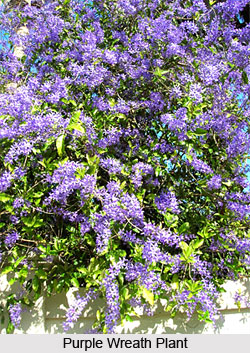 The `Purple Wreath` can make a glorious show in the spring over a porch or along a veranda. The countless flower sprays appear at this time. The sprays are long and lilac in colour. The shrub has another lesser flowering season towards the end of the year. The tapering clusters bear a lot of pale, blue-mauve coloured stars. These stars become deeper in colour towards the end. They grow nearly in pairs, on a short stem and usually turn in order to give each flower a chance to face the light. However, people often think wrongly about the calices to be the flowers. These calices remain in the shrub even after the flowers have fallen. The original flower of the `Purple Wreath` is a tiny affair that has five petals. The affair is of deep purple velvet colour and it may be seen resting in two or three of the end calices.
Among the five petals, one purple petal has a white splash in the middle. The flower sprays are usually drooping and gracefully arched and they spring from the axils of the leaves. The plant does not bear fruit in India. The oval shaped leaves of the `Purple Wreath` are quite large. They can grow up to 12.4 or 15 cm and they are deeply veined. Being very stiff and rough, the leaves are of a dull-green colour above and brighter underneath. The young leaves are of a fresher green but they are also stiff. They are never soft and limp like the young leaves of most other plants. The flower is a charming one to cut for the house. However, you may find that if the woody stem is cut, the blooms will very quickly droop and die. Anyway, if only the flower-sprays are cut and arranged in a shallow bowl, they will remain fresh for several days. The plant usually sends up several suckers that can be removed to form new plants. In other way, a branch can be bent down and anchor to the ground where it will quickly root.