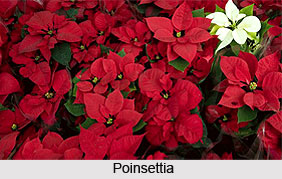
 The colourful shrub named as the `Poinsettia`, is very much popular for it`s bright red bracts. The scientific name of this shrub is `Euphorbia Pulcherrima`. It is a member of the family named `Euphorbiaceae`. This is known as `Lal Pate` in Hindi language. The tree has a lot of names in English language. They are: the `Poinsettia`, `Christmas Plant`, `Lobster Plant` and `Mexican Flame Leaf`. Indian people do use this nice shrub in order to brighten and make their gardens more attractive.
There are many varieties of the `Poinsettia` and all of them have the same peculiarity. The peculiarity is the extreme degeneration of the flowers. The coloured leaves are a part of the bracts flowers but not of the flowers. The bracts are brightly coloured to attract insects. The clusters of the degenerated flowers are rounded and form like buds. They also bear some up-standing stamens and peculiar side bumps. Each "stamen" is all that exists of a male flower, and the bulky "pistil" is all there is of a whole female flower. Some of the varieties of this shrub are very far removed from our common garden plants, as they are merely some roadside wild plants. Some other varieties are like miniatures containing only a small area of scarlet. The others have no scarlet at all and they have an ugly greenish-yellow coloured area. The horticulturists have introduced a lot more varieties that suggest that the shrub has double forms. One form is where the red colour is replaced by pink or yellow or white and the other with multicolored leaves.
The bark of the `Poinsettia` is a short, thick trunk that is uneven. It is brown in colour. The branches are slim and of green colour. They spread into an open bush formation and bear most of their leaves towards the end. The new leaves of the shrub are soft, bronze and downy. They become green coloured and then hard and leathery by age. They are deeply scored by the veins. Each of the branchlets ends with a circle of bracts that surround a small cluster of "flowers". The bracts are usually about 12.5 cm in length and half that in width. The `Poinsettia` also exudes a milky white sap from a part of itself, as it is a common characteristic of many other poisonous plants as well. So, you should be very careful while handling its cut branches.
Both the leaves and bracts of the shrub droop very quickly after cutting. So if you require the sprays for indoor decoration, you should plunge the cut ends immediately into boiling water to the depth of 5 cm. By this, you will be able to preserve their freshness for a considerable time. The `Poinsettia` requires full sun and good drainage to thrive well and should be cut down to about 30cm. after flowering.