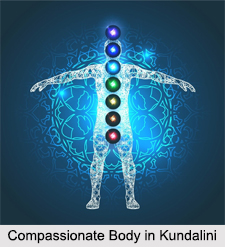
 This is the first of the four bodies of the spiritual self. It serves as an equilibrium between the personality and other spiritual bodies. It is also a vehicle for contact with the universal mind that brings perceptivenesses and discernments to the human level. It is the foundation of ideas, resulting from abstract thinking or awaring (as opposed to the concentrate logical thinking of the mental body). The intuitional/ compassionate body also pertains to understanding (really in another word for compassion). It is sometimes called the Buddhic body, after the compassionate Buddha.
During maturation of this body, intuition may wax and wane. It is difficult at times to determine the exactness of received information, but holding the energy of the intuition in the body can help one come to a decision. When it reverberates deep inside the self, it is normally right. However, one needs to be patient and learn how to use it.
Cleansing the Intuitional/Compassionate
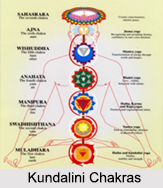
Kundalini flowing through this body may result in an overabundance of compassion. A person may be overpowered with love for others and for the world. Negative energy may take the form of self-pity. In any event, these feelings are generally out of symmetry. By relieving the surplus energy, it allows the system to feel light and floating. Lying down can help in such circumstances; it is advised to fill oneself with a blue colour and sustain a feeing of floating for approximately thirty minutes. This can help balance the energies.
This Too Shall Pass
Firstly, one needs to understand what is taking place is temporary and that there is a purpose to being cleansed and polished. One must be conscious of his/her depths of despondency, disenchantment, misery, or whatever the experience is, and breathe into it. Next, one needs to go into it profoundly, until one comes to the "silver lining", or break through to peace and joy.
Suffering is the Other Side of Joy
Suffering broadens an individual, allowing fresh understanding to arrive through and new energy to flow in. Firstly, one needs to fill the body with a taffy colour. Courageously and faithfully, one should let the feelings of suffering be lengthened and opened, until joy and peace flows in.
Spiritual Breathing
It is advised to breathe into the top part of the lungs, and feel expansion. One needs to be uplifted by this splendid energy. This helps activate spiritual centres, reducing surplus energy in the emotional and mental areas and helps in clear and cleanse.
The Ultimate
Humans generally live by intuition, consciousness and insight. People love and feel compassion without getting caught in other people`s `stuff`. There is a striking balance between the human and spiritual aspects of life. There is also a fresh understanding of God and the universe.