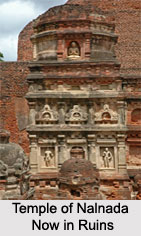
 Temple of Nalanda has architecture of early India. Now the architecture is in ruins, but it marks the importance of education and the value of parallel religion system in early India. Buddhism emerged during Gupta rule, while Bimbisara attained Buddhism.
Nalanda in ancient era was the "Mahavihara" in early India. It was a large Buddhist monastery in the ancient kingdom of Magadha.
Location of Nalanda
Nalnada is located about 95 kilometres southeast of Patna near the town of Bihar Sharif. It was the centre of learning from the 5th century BC to 1200 BC.
Nalanda in Ancient era
Nalanda was originally an affluent village by a major trade route that ran through the nearby city of modern Rajgir which was then the capital of Magadha. It is said that the Jain thirthankara, Mahavira, spent fourteen rainy seasons at Nalanda (now in nalanda District of Bihar).
Temple in Nalanda
The main temple of Nalanda is standing at the southern extremity of the excavation area. The row of temple at once make the tourist to see the pictogram of Aryabhata, Aryadeva, student of Nagarjuna, Atisha, Mahayana and Vajrayana scholar, Chandrakirti, student of Nagarjuna, Dharmakirti, logician, Dharmapala, Dignaga, founder of Buddhist Logic, Nagarjuna, formaliser of the concept of Shunyata, Naropa, student of Tilopa and teacher of Marpa, Shilabhadra, the teacher of Hiuen Tsang, Hiuen Tsang, Chinese Buddhist traveller, Padmasambhava and Yijing, Chinese Buddhist traveller.
Architecture of the Temples of Nalanda
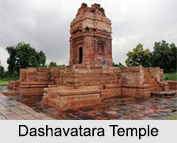
The temple of Nalanda has the largest and most imposing structure. The temple is a huge solid structure of the temple remaining, standing in the middle of a court. It is surrounded by a number of small votive stupas, many of which were twice or even three times that built one over the other on the same spot.
Excavation of Nalanda Temples
In the course of excavations of Nalanda, the temple was found that the very small original structure was enlarged by later temples built over an around the ruins of the earlier ones, the present mound being the result of seven successive accumulations.
Stupas of Nalanda Temples
The votive stupas sometimes contain in their core bricks inscribed with sacred Buddhist texts. The inscriptions belong to the sixth century A.D.
Stucco figures in Nalanda Temples
The stucco figures of Nalanda are of the fine specimens of Gupta art. As the structure of Nalanda increased in size with each addition, the level of the court gradually rose, and many small votive stupas are found at several places completely or partially buried under the different floors and walls that have been exposed.
Chamber of Nalanda
The shrine chamber of Nalnada on the top, facing north, and can be approached by the staircase of the sixth period.