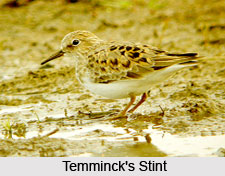
 Temminck`s Stint is an Indian Bird that bears a scientific name "Calidris temminckii" and it has the family name "small wader".
Breeding Habitats of Temminck`s Stint
Temminck`s Stint breeding habitat is bogs and marshes in the taiga of Arctic northern Europe and Asia. It will breed in southern Scandinavia and occasionally Scotland. It has a distinctive hovering display flight.
Nests of Temminck`s Stint
Temminck`s Stint nests in a scrape on the ground, laying 3 to 4 eggs. Temminck`s Stint is strongly migratory, wintering at freshwater sites in tropical Africa, the Indian Subcontinent and parts of Southeast Asia.
Forage of Temminck`s Stint
Temminck`s Stint forages in soft mud with some vegetation, mainly picking up food by sight. They have a distinctive mouse-like feeding behaviour, creeping steadily along the edges of pools.
Prey of Temminck`s Stint
Temminck`s Stint mostly eats insects and other small invertebrates. Temminck`s Stints are not as gregarious as other Calidris waders, and rarely form large flocks.
Structure of Temminck`s Stint
Temminck`s Stint is a very small wader, at 13.5-15 cm length similar in size to little stint, Calidris Erolia minuta. They are shorter legged and longer winged than Little Stint. The legs are yellow, and the outer tail feathers white, in contrast to little stint`s dark legs and grey outer tail feathers.
Size of Temminck`s Stint
Temminck`s Stint is a rather drab wader, with mainly plain brown upperparts and head, and under parts is white apart from a darker breast. The breeding adults of Temminck"s Stint have some brighter rufous mantle feathers to relieve the generally still undistinguished appearance. In winter plumage, the general appearance recalls a tiny version of common sandpiper. The call is a loud trill.
Stints of Temminck`s Stint
The Temminck`s stint have an intriguing breeding and parental care system in which males and female incubate separate clutches, typically in different locations. The male Temminck`s Stint establishes small territories and mate with a female who lays a first clutch of eggs. She then moves to a second territory and mate, and lays a second clutch that she incubates herself. Concurrently, her first male may mate with an incoming second female, who lays her second clutch on his territory. The male thereafter incubates his first mate`s first clutch alone.