 The twelfth yoga sutra defines about the `final transformation` that one achieves after the consciousness has been elevated to the level of the soul and has becime one with it. It is referred to as ekagrata parinama. This, however, cannot be reached by mere concentration. The vacillations of the mind must be curbed and it needs to be brought into a one-pointed consciousness. In order to calm the citta, an uninterrupted flow of attention must be obtained. At times, the consciousness spurts out in activity, which must be restrained and checked. And this process is time consuming. When this transformation occurs - time and consciousness are fused into one, ekagrata parinama occurs.
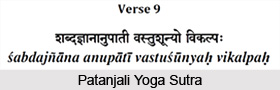
tatah then
punah again
santa subsiding state, quiescent state
uditau rising state
tulya similar
pratyayau cognitions, means of action, cause
cittasya of consciousness (mind)
ekagrata (eka = singular, one, alone, unique, pre-eminent; agra = first, a resting place, base, prominent, excellent, best, chief and summit; ekagra = turned towards one point, intent upon one object: here, ekagra means the indivisible (abhedya) soul and the foundation of life) one-pointedness
Pannamah transformation
When rising and falling thought processes are in balance, one-pointed consciousness comes forth. Maintenance of awarenesss with keen intensity from one-pointed attention to no-pointed attentiveness is ekagrata parinama.
Even in this focus on the property of citta alone, the sensitivity of attention may be intense or light. To preserve a steady, uninterrupted flow and intensity of attention in citta is the third phase of transformation.
Occasionally, consciousness is thoughtfully silent, but then it suddenly spirts out into vivacious activity. In a split second, this activity may be controlled and balance regained. This control needs effort, and effort calls for time. By skillful practice, the depth of silence, which at first appears only in fleets, is made to interpenetrate and fill the entire citta. Then the feeling of time disappears. Past and future are reabsorbed into the timeless.
Mind and time are interdependent. As the moments of the mind come to an end, so does time. Citta and the seer (atman) are the two sharp edges of a blade. In one-pointed attention (ekagrata samskara) the energies of the seeker and the seer become one.
When the state of restraint is reached (nirodha samskara), glimpses of silence are nurtured and fill the consciousness (samadhi samskara). Then the third phase of ekagrata samskara should be practised. Here, the consciousness which was dependent on external objects moves inwards to infuse the seedless seat of the soul.
In.9-12 Patanjali explains the three levels of transformation of consciousness in sequential order - nirodha, samadhi and finally ekagrata. Ekagrata, as explained earlier, has two meanings. One is concentration on a given object - at this external level it bears the same meaning as dharana. The other is `one without a second` - i.e., the soul. This level of transformation of consciousness is the highest. Patanjali thus states his meaning as - ekagrata parinama is the final phase of the transformation in which consciousness is uplifted to the level of the soul, and is one with it.