
The tatah parama vasyata indriyanam sutra speaks about the ultimate stage in pratyahara, wherein one finds the true meaning in life. The sadhaka is in total control over his senses, he is the master of his own consciousness and every worldly dichotomy ceases to exist.
Tatah then, from that
Parama the highest
vasyata subdued, controlled, governed
indnyanam of the senses
Pratyahara results in the absolute control of the sense organs.
The effect of pratyahara is felt when the senses are mastered, and the mind is mature and fervent for its spiritual quest.
When the senses have ceased to pursue after pleasures obtained from the phenomenal world, they can be yoked to serve the soul.
Sadhana pada instructs the sadhaka how to study his own weaknesses in every domain - moral, physical, physiological and intellectual - and how to eradicate them, since they are not contributory to yogic discipline and spiritual emancipation.
Yama germinates the art of living in society honestly; niyama, that of cleansing one`s impurities. Asana eradicates physical and mental disturbances, and pranayama maintains harmony and prevents dissipation of the flow of vital energy, making the mind a fit instrument for meditation. Pratyahara sublimates both senses and mind.
Thus ends the external quest (bahirahga sadhana). Now the sadhaka crosses the threshold of the internal quest (antarahga sadhana) of yoga.
Here ends the exposition on sadhana, the second pada of Patanjali`s Yoga Sutras.
In this pada Patanjali speaks of the properties of yoga and the art of assimilation (samyama) through concentration, meditation and profound absorption.
Tatah parama vasyata indriyanam
This is the fifty-fifth yogic sutra that is contained within the second phase of the Patanjali Yoga Sutras.
Recently updated articles in Yoga
Khanda Manda Yoga
Khanda Manda Yoga is a difficult form of yoga where the Yogi cuts off his own arms and legs with a sharp cleaver, that is axe-like knife, and throws t...
Kaivalya Pada
Kaivalya Pada, the fourth chapter of Patanjali Yoga Sutra denotes an absolute, indivisible state of existence of the Yogi. The Kaivalya Pada is someti...
Vibhuti Pada
Vibhuti is the Sanskrit term for “power” or “manifestation.” In this third chapter, Patanjali introduces the final three limbs of Aṣṭanga Yoga, collec...

Sadhana Pada
Sadhana Pada in Patanjali Yoga Sutra denotes the idea of practicing yoga that leads to spiritual illumination. Sadhana, the Sanskrit term for “practic...
Samadhi Pada
Samadhi Pada is the first chapter of Patanjali Yoga Sutra. In this chapter, the author explains the essence of yoga, the nature of samadhi, and the me...
Related articles in Yoga
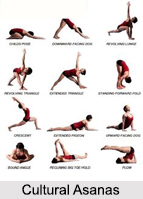
Cultural Asanas
Cultural Asanas refer to the daily physical exercise postures that train the body and mind in Yoga Practice.
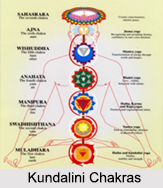
Kundalini Chakras
Kundalini Chakras are psychic energy centres or vortices, which connect between our psychic and physical energy systems.
Patanjali Yoga Sutras
Patanjali’s Yoga Sutras presents a foundational guide to the philosophy and practice of yoga. Through concise aphorisms, it outlines the nature of the...
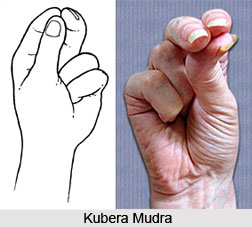
Kubera Mudra
Kubera Mudra, a form of Hatha Yoga, leads to the elevation of mental peace and physical relief by proper practice and cleanses frontal sinuses.