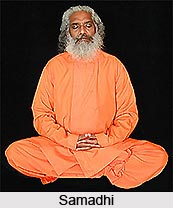
 The tadeva arthamatranirbhasam svaritpabunyam iva samadhih sutra states about the essential aspects of samadhi, and how it can be gained. Samadhi can only be attained when the sadhaka, who is meditating, is so engrossed in his work that he become one with the object of meditation. However, the attentive consciousness must be fused with the sadhaka, and also with the object of meditation. And, when one is in such a state of elevated vision, every aspect of life is touched and diffused by such contemplation.
tadeva the same (dhyana)
onha object, purpose, aim, end, wish, desire
matra alone, only
nirbhasam appearing, shining
svarupa essential form, by itself
svnyammempty, void
iva as if, as it were
samadhih perfect absorption, intent attention, union, bringing into harmony, spiritual absorption
When the object of meditation engrosses the meditator, appearing as the subject, self-awareness is lost. This is samadhi.
When the attentive flow of consciousness fuses with the object of meditation, the consciousness of the meditator, the subject, appears to be dissolved in the object. This union of subject and object becomes samadhi.
When the object of contemplation shines forth without the interference of one`s own consciousness, dhyana flows into samadhi.
When a musician loses himself and is completely enwrapped in his music, or an inventor makes his discoveries when devoid of ego, or a painter surpasses himself with colour, shade and brush, they glimpse samadhi. So it is with the yogi - when his object of contemplation becomes himself, devoid of himself, he experiences samadhi.
The dissimilarity is that the artist or musician arrives at this state by effort, and cannot sustain it; while the yogi, remaining devoid of ego, experiences it as natural, continuous and effortless. Therefore it is difficult for an artist to instill his vision of the sublime, which is associated with the performance and realisation of a particular art form, into his common daily existence. For the yogi, however, whose `art` is formless and whose goal has no physical expression like a painting, a book or a symphony, the fragrance of samadhi imbues every aspect of his `normal` behaviour, activities and state of being.
Uninterrupted flow of attention dissolves the rip between the object seen and the seer who sees it. Consciousness appears to have ceased, and to have reached a state of silence. It is devoid of `I`, and unites into the core of the being in an unfathomed state of serenity. In samadhi, awareness of place vanishes and one ceases to experience space and time.