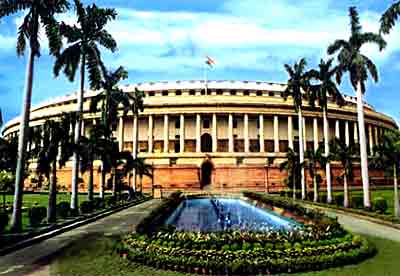
 System of Election in India is based on the principle of first-past-the-post. This means that as far as elections to the Lok Sabha are carried out, the system of majority win is followed. The country is split up into separate geographical areas, known as constituencies, and the electors can cast one vote each for a candidate (although most candidates stand as independents, most successful candidates stand as members of political parties), the winner being the candidate who gets the maximum votes.
The Parliament of the Union consists of the President, the Lok Sabha (House of the People) and the Rajya Sabha (Council of States). The Indian President is the head of state, and he appoints the Indian Prime Minister, who runs the government, according to the political composition of the Lok Sabha. Although the government is headed by a Prime Minister, the Cabinet is the central decision making body of the government. Members of more than one party can make up a government, and although the governing parties may be a minority in the Lok Sabha, they can only govern as long as they have the confidence of a majority of Members of Parliament, the members of the Lok Sabha. As well as being the body which determines who makes up the government, the Lok Sabha is the main legislative body, along with the Rajya Sabha.
System of Elections to Rajya Sabha
The members of the Rajya Sabha are elected indirectly, rather than by the citizens at large. Rajya Sabha members are elected by each state Vidhan Sabha using the single transferable vote system. Unlike most federal systems, the number of members returned by each state is roughly in proportion to their population. There are also members nominated by the President as representatives of literature, science, art and social services. Rajya Sabha members can serve for six years, and elections are staggered, with one third of the assembly being elected every 2 years.
The president can nominate 2 members of the Lok Sabha if it is felt that the representation of the Anglo-Indian community is inadequate and 12 members of the Rajya Sabha, to represent literature, science, art and the social services.
System of Election in State Assemblies
India is a federal country, and the Constitution of India gives the states and union territories significant control over their own government. The Vidhan Sabhas (legislative assemblies) are directly elected bodies set up to carry out the administration of the government in the States of India. In some states there is a bicameral organisation of the legislatures, with both an upper and Lower House. Two of the seven Union Territories viz., the National Capital Territory of Delhi and Pondicherry, also have legislative assemblies.
Elections to the Vidhan Sabhas are carried out in the same manner as the Lok Sabha election, with the states and union territories divided into single-member constituencies, and the first-past-the-post electoral system used. The assemblies range in size, according to the population of the state. The largest Vidhan Sabha is for Uttar Pradesh, with 403 members; the smallest is Pondicherry, with 30 members.
System of Election of President and Vice-President
The President is elected by the elected members of the Vidhan Sabhas, Lok Sabha, and Rajya Sabha, and serves for a period of 5 years (although they can stand for re-election). A formula is used to allocate votes so there is a balance between the population of each state and the number of votes assembly members from a state can cast, and to give an equal balance between State Assembly members and National Parliament members. If no candidate receives a majority of votes there is a system by which losing candidates are eliminated from the contest and votes for them transferred to other candidates, until one gain a majority. The Indian Vice President is elected by a direct vote of all members elected and nominated, of the Lok Sabha and Rajya Sabha.