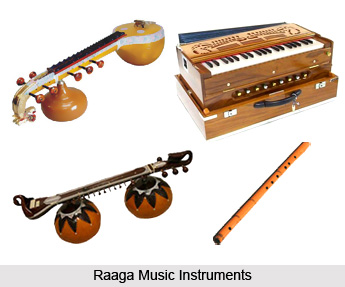
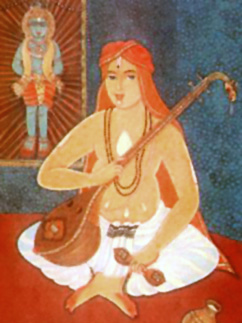
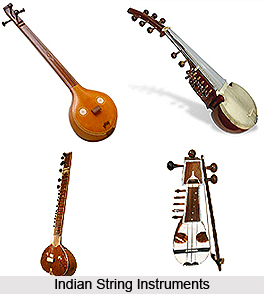
 String Instruments used in Indian Classical Music are an important part of the performance. The string instruments are of many different types. Of the stringed instruments, the Tambura is the most important as an instrument of accompaniment. No singer of repute will ever give a performance without two Tamburas forming the basis of accompaniment, with their powerful and resonant drone. It is a long and graceful instrument, with a big head, and four strings tuned to Pa, Sa, Sa, Sa. These strings are gently pulled by the fingers, one after the other in a continuous succession giving a constant drone without sounding any particular tune. This forms a perfect base for the human voice, and keeps the singer in tune.
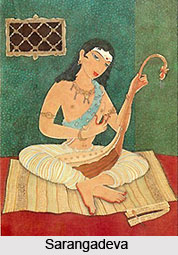
The Veena consists of a pea-shaped bowl hollowed out of one piece of wood. It has a rather peculiar arrangement of strings and frets, and the Veena lends itself very beautifully to all the graces of Indian music. The Veena is held either horizontally across the knees, or in a slanting position resting on the shoulder, and is also manipulated by the fingers. It is a solo instrument of the finest kind and is generally played by professionals.
The Sarangi is quite like a sample of the violin and is an instrument used by both experts as well as the wandering minstrels of India. Its tone is mellow and has fullness, being played by a bow drawn across it. The Sarangi is both a solo instrument as well as an effective accompaniment for the singer.
The Sitar and the Dilrooba are two other rather elegant instruments which are used by professionals and amateurs alike. Simple melodies can be played on them and at the same time, they can be used to demonstrate the technicalities of the art by an expert musician. The former is constructed somewhat like the Veena, and the latter is shaped something like the Sarangi, and like it is played with a bow. Both these instruments are purely solo instruments and are not used to accompany the voice.