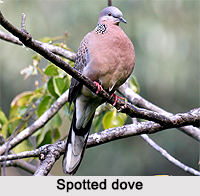
 Spotted Dove is an Indian bird that bears a scientific name "Spilopelia chinensis" and it a common resident breeding bird across its native range on the Indian states and Southeast Asia.
Description of Spotted Dove
Spotted Dove was formerly included in the genus Streptopelia with other Turtle-Doves, but they differ from typical members of that genus.
Structure of Spotted Dove
Spotted Dove is long tailed buff brown with a white-spotted black collar patch on the back and sides of the neck. The tail tips are white and the wing coverts have light buff spots. There are considerable plumage variations across populations within its wide range. The species are found in light forests and gardens as well as in urban areas. They fly from the ground with an explosive flutter and will sometimes glide down to a perch. It is sometimes also called the Mountain Dove, Pearl-Necked Dove or Lace-Necked Dove.
Colour of Spotted Dove
The ground colour of Spotted Dove is rosy buff below shading grey on the head and belly. There is a half collar on the back and sides of the neck made of black feathers that bifurcate and have white spots at the two tips. The back has brown feathers with rufous spots in the Indian and subspecies. The lesser median coverts are grey brown. The Indian populations have these coverts with rosy spots at the tip divided by a widening dark grey streak along the shaft. The primary coverts are dark brown. The wing feathers are dark brow with grey edges. The centre of the abdomen and vent are white. The outer tail feathers are tipped in white and become visible when the bird takes off. Sexes are similar, but juveniles are duller than adults and do not acquire the neck spots until they are mature. The length ranges from 28 to 32 centimetres.
Concentration of Spotted Dove
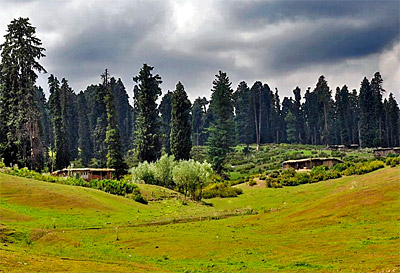
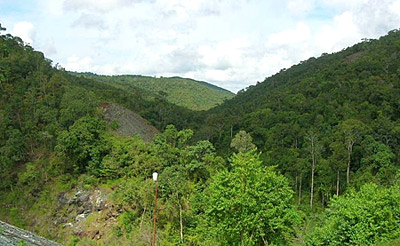
Spotted Dove in its native range in Asia is found across a range of habitats including woodland, scrub, farmland and habitation. In India it tends to be found in the moisture regions, with the laughing dove being commoner in the drier areas. These doves are mostly found on the ground where they forage for seeds and grain or on low vegetation.
Residence of Spotted Dove
Spotted Dove has become established in many areas outside its native range. These areas include Hawaii, southern California, Mauritius, Australia and New Zealand. In Australia, they were introduced in Melbourne in the 1860s and have since spread, often replacing native doves. They are now found in streets, parks, gardens, agricultural areas and tropical scrubs in diverse locations across Australia. The original populations appear to be chinensis and tigrina in varying proportions
Behaviour of Spotted Dove
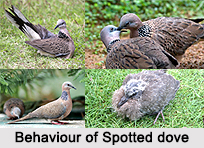
Spotted Doves move around in pairs or small groups as they forage on the ground for grass seeds, grains, fallen fruits and seeds of other plants. They may however take insects occasionally and have been recorded feeding on winged termites. The flight is quick with regular beats and an occasional sharp flick of the wings. A display flight involves taking off at a steep angle with a loud clapping of the wing and then slowly gliding down with the tail spread out.
Breeding Season of Spotted Dove
The breeding season of Spotted Dove is spread out in warm regions but tends to be in summer in the temperate ranges. In Hawaii, they breed all year round, as do all three other introduced species of doves. Males coo, bow and make aerial displays in courtship. In southern Australia, they breed mostly from September to January and in the north in autumn.
 They nest mainly in low vegetation, building a flimsy cup of twigs in which two whitish eggs are laid. Nests are sometimes placed on the ground or on buildings and other structures. Both parents take part in building the nest, incubating and feeding the young. The eggs hatch after about 13 days and fledge after a fortnight. More than one brood may be raised.
Population of Spotted Dove
Spotted Dove has been extending its range in many parts of the world. Populations may sometimes rise and fall rapidly, within a span of about five years. In the Philippines, the species may be out-competing Streptopelia bitorquata. Their habit of flushing into the air when disturbed makes them a hazard on airfields, often colliding with aircraft and sometimes causing damage.