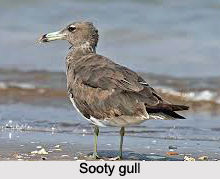
 Sooty Gull is an Indian Bird that bears a scientific name "Ichthyaetus hemprichii". It is a species of gull in the family Laridae, also known as the Aden Gull or Hemprich`s Gull.
Concentration of Sooty Gull
Sooty Gull is found in Bahrain, Djibouti, Egypt, Eritrea, India, Iran, Israel, Jordan, Kenya, Lebanon, Maldives, Mozambique, Oman, Pakistan, Qatar, Saudi Arabia, Somalia, Sri Lanka, Sudan, Tanzania, United Arab Emirates, and Yemen.
Description of Sooty Gull
Sooty Gull is named in honour of the German naturalist Wilhelm Hemprich who died in 1825 while on a scientific expedition to Egypt and the Middle East with his friend Christian Gottfried Ehrenberg.
Migration of Sooty Gull
Sooty Gull is native to the Red Sea, the Gulf of Aden, the Gulf of Oman, the Persian Gulf and its range extends as far east as Pakistan. It is also native to the east coast of Africa as far south as Tanzania and Mozambique. It occurs as a vagrant in India, Sri Lanka, the Maldives, Jordan, Lebanon, Israel and Bahrein.
Flight of Sooty Gull
It is a coastal bird, seldom going further out to sea than about 10 km beyond coastal reefs although it has occasionally been seen 140 km from land. It frequents ports and harbours, the coast, inshore islands and the intertidal zone. It seldom moves inland or visits freshwater locations. It is nomadic or partially migratory and many populations move southwards after breeding, though Red Sea populations seem to be relatively sedentary.
Behaviour of Sooty Gull
Sooty Gull is a predator and scavenger in nature. Sooty Gull feeds on discarded fish and fish offal, other small fish that it catches itself, prawns, newly hatched turtles and the eggs and chicks of other sea birds.
Breeding Season of Sooty Gull
The breeding season of Sooty Gull takes place during the summer.
Nests of Sooty Gull
Sooty Gull usually nests in small colonies on inshore coral islands, particularly outer islands protected by reefs with rock, sand and sparse vegetation. Nests are sometimes solitary, particularly in Africa, or may be scattered among the nests of other colonial sea birds. The nest may consist of a bare scrape in the coral in an exposed position or may be protected by a coral overhang or sheltered beneath a low-growing mangrove or a seep weed bush.