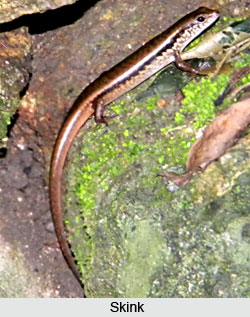
 Skink is a very small ground-dwelling lizard easily recognized by its glossy scales. It has enlarged symmetrical shields on the head, a broad flat tongue and movable eyelids. The small limbs and elongated body gives it the appearance of snakes. Skink is striped, cross-barred or spotted and lacks the ability to change colour but the male skinks acquire red or orange hues during the breeding season. These skinks are the most common lizards of the world with over six hundred species. About half the species of the skinks lay eggs, and the rest of them bear living young. These reptiles are generally insectivorous.
In India there are about thirty eight species of thirteen genera, ranging in size from the four centimetres long Ristella travancorica to the forty five centimetres long Mabuya tytleri. The limbless skink, Barkudia insularis, is found on Barkula Island in Chilka Lake and Waltair. The yellow-bellied mole skink of Kashmir Eurneces taeniolatus is a secretive lizard which remains hidden in a burrow or under rocks for most of the day. The desert skink, Ophiomorus tridactylus, is called `sand fish` because it `swims` its way under the sand. It can burrow up to thirty centimetres under the ground and emerges only after sunset.
Striped skinks of the genus Mabuya move with remarkable speed when pursued. Of these, the common skink, M.dissimilis of North India and Pakistan are well known. The Himalayan skink, Scincella himalayanum, shuns light and lives in damp, cool places. It bears live young. The burrowing cat skinks of the genus Ristella are restricted to the hills of South India. They have clawed toes and scaly lower eyelids.
These are very much similar in appearance to the actual lizards, but a majority of the species of skinks possess no pronounced neck and bear very small legs. A number of genera (e.g., Typhlosaurus) possess no limbs, while some others like Neoseps, have very small limbs. They move like snakes more than that of various other types of lizards. These reptiles are usually carnivorous and mainly eat insects, which includes grasshoppers, beetles, crickets and caterpillars. Skinks also have their food as snails, slugs, earthworms, isopods, several other lizards and small rodents. Some other species, mainly those which are favourable home pets, possess more varied diet with about forty percent meat products or meats or do or cat foods and sixty percent vegetables. The predators of Skinks are Raccoons, possums, foxes, snakes, crows, coatis, cats, herons, dogs, kookaburras and hawks.