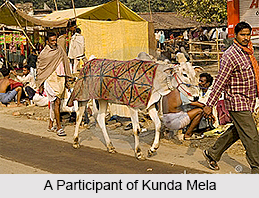
 The Simhastha Kumbh is the great bathing festival of Ujjain in the Indian state of Madhya Pradesh. The festival is celebrated in a cycle of twelve years when Sun and Jupiter enters the sign of Aries and Leo respectively. The Simhastha festival is celebrated for almost a month that brings together millions of people from across India and abroad. Ceremonial bathing in the holy waters of Shipra begin with the full moon day of Chaitra and continue in different intervals throughout the successive month of vaishakha culminating on the full moon day. The devotees during the month of April-May gather to take holy dips in the holy Sipra River. They also get the opportunity to enjoy the company of seers and saints, listen to religious discourses, witness the Ramlilas and Raslilas, visit the various `akharas` and watch the grand processions of `sadhus.` They imbibe the spirit of the devotion-filled ambience where Lord Shiva is omnipresent.
Origin of Simhastha
The origin of Simhastha is related to the mythological story of Samudra Manthan or churning of the ocean. According to the story the gods and demons churned the ocean and found an Amrita Kund, a vase that contained nectar. To ensure that the urn did not fall in the hands of the demons, the gods handed it over to Brihaspati, the Moon God, the Sun God and the Saturn. However when Jayant, the son of Lord Indra ran away with the urn, the demons chased him that led to a fierce continuing upto twelve days. According to a myth one day in the lives of the gods equals one year of the humans. Hence in that way the battle lasted twelve years. In the struggle to possess the urn, some drops of the nectar fell on four points in India - Haridwar, Prayag, Nashik and Ujjain. Legend has it that these drop developed into four sacred rivers - the Ganga River, the Yamuna River, the Godavari River and the Sipra River. Different planetary positions, like the crossing of Jupiter into Leo sign and certain other conjunctions for the fair at Ujjain, are noted for the Kumbha Mela at these other places also.
In India four Kumbh Melas are held every twelve years in Prayag (Allahabad), Haridwar, Nashik and Ujjain. The Kumbh at Ujjain is called Simhastha when the Sun enters the Aries and the Jupiter is in the Leo. The Kumbh in Hardwar is held when the Sun is in the Aries and the Jupiter in the Aquarius. The Kumbh in Prayag occurs when the Sun is in the Capricorn and the Aries in the Taurus. The Simhastha at Ujjain has a special significance as a rare configuration of planets takes place in 12 years with the Sun in the Aries and the Jupiter in the Leo.