 Selaginella is a genus of plants in the family Selaginellaceae which includes Spikemoss. It is still positioned in the class of Lycopsida (modern nomenclature: Lycopodiopsida). This group of plants is included in a group called "fern allies".
Characteristics of Selaginella
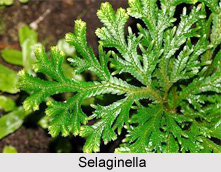
Selaginellas have scale-like leaves on branching stems from which roots also arise. They are specifically creeping or ascendant plants. They have structures called ligules, scale-like outgrowths near the base of the upper surface of each microphyll and sporophyll and are heterosporous (megaspores and microspores). Unusually for the lycopods, each microphyll contains a branching vascular trace. These are epiphytic heterosporous, protostelic plants encompassing only one form and about 700 species. The free-living sporophytic plant consists of a rhizome with adventitious roots. It has an aerial portion with numerous, intimately spaced apart and with dimorphic microphyllous leaves, each with a single vascular trace and each with a minute basal flap of tissue called a ligule. The fertile point has two kinds of sporangia, Megasporangia and Microsporangia. While the former produces four large, megaspores that give birth to female gametophytes the later one produce hundreds of tiny microspores that give rise to male gametophytes.
Scientific Classification of Selaginella
Kingdom: Plantae
Division: Lycopodiophyta
Class: Selaginellopsida
Order: Selaginellales
Family: Selaginellaceae
Genus: Selaginella
Many species of Selaginella grow in deserts and are known as "resurrection plants", because they curl up in a tight, brown or reddish ball during dry period, and uncurl and turn green when they get moisture. Other species grow in tropical regions. The lycophytes dominated the earth`s landscape during the Carboniferous Period (354-290 million years ago) and their remains can be seen and used today in the form of coal. The spikemoss Selaginella moellendorffii has a genome size of only 100Mbp, which is the smallest genome size of any plant reported.
This article is a stub. You can enrich by adding more information to it. Send your Write Up to content@indianetzone.com