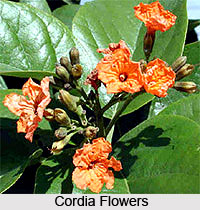
 Though there are a lot of `Cordia` trees that are native to India, but the most wonderful and beautiful amongst them is the `Scarlet Cordia Tree`. Bearing the scientific name of `Cordia Sebestena`, the tree was imported to India many years ago because of its enormous ornamental values. The name `Cordia` honours a German botanist of the 16th Century Euricius Cordus and his son Valerius and the word `Sebestena` has derived from the Persian word `Sapistan` and it means having fruit like Sebestens. The name of its family is `Boraginaceae`. The Hindi speaking people call it as `Bhokar` and `Bohari` and in Telugu, it is known as `Virigi`. It is also called as the `Aloe Wood Tree` or `Ginger Tree`.
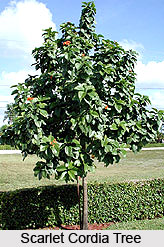 In India, the Scarlet Cordia can be found as a small tree or garden shrub, but in its native places, it can reach the height of about 12 m. It loves the sandy and sun-baked conditions. Be it small or tall, the `Scarlet Cordia Tree` always has a short and twisted trunk that is wide in comparison with the height. The bark of the tree is brown coloured and wavy. The clusters of sparkling, bell-like flowers remain speckled amongst the deep foliage. They are a treat to the eye with their rich hue all through the year. Each of the flowers of the tree is about 2.8 cm across. A finely pleated tube is placed in neatly into a long and olive-brown in colour calyx. The tube split into six curved petals. The petals are deeply wrinkled and ruffled. In one close cluster, one may find up to a dozen blooms.
The fruit of the `Scarlet Cordia Tree` is unique. They are of pure white colour and contain five lobes. They stay enclosed in the rest of the calyx. The flesh of the fruit has a scent that reminds us about that of bananas. The leaves are unusual to look at and also to touch. They are large in size and oval shaped. They are dull at the top and very deeply concaved by the veins. On the underside the veins form hard ridges. The colour of the vein is dark green, particularly dark in the older leaves. The texture of the leaves is as harsh as sandpaper. Although limp, even the young leaves are also rough. Both the parts of the fruit of this tree have some medicinal qualities. Despite its softness, the wood is strong and durable and is claimed to be one of the timbers used to make Egyptian Mummy cases. It is also better than most of the woods used for the purpose of procuring fire by friction.