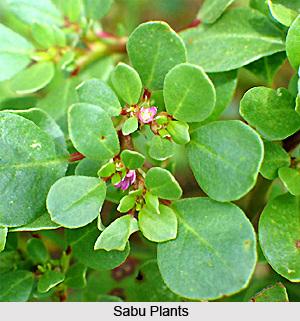
 Sabu plant is prostrate, glabrous and succulent annual herb. The leaves of this plant are broadly obovate, opposite and unequally paired which are 3.5 cm long and 3 cm wide. Its flowers are pink or sometimes white in colour and are partly hidden by sheathing leaf-bases. Fruits or capsules of this plant are 0.5 cm long and 0.3 mm broad which are dull black in colour. The species of Sabu plants are found in two forms: one with red stems, leaf margins and flowers; another with green stems and white flowers.
It plays a major role in medicinal properties. The roots of Sabuni are used in Ayurveda in external applications for treating corneal ulcers, itching, dimness of sight and night blindness. They are also employed as a substitute for the Ayurvedic drug `Punarnava` which is used to stimulate kidney and heart function and as a specific for jaundice, diabetes, general debility and beriberi. A mixture of the roots is given internally to relieve constipation, strangury and dropsy. They are also used to treat obstruction of the liver, asthma and amen-orrhoea. The powdered roots are treated for nauseous and irritant properties which are used in combination with ginger as a cathartic and abortifacient. The leaves of the white variety are diuretic and used for treating oedema, dropsy and ascites. A decoction of the herb is used as a vermifuge, as an antidote to alcohol poisoning and for treating rheumatism.
The botanical name of Aizoaceae Trianthema portulacastrum L. plant is Trianthema monogyna L and popularly known as Gadabani, Sabun in Bengali, in English it is known as Horse Purslane; Sabuni, Salsabuni, Santhi and Svetsabuni in Hindi; Komme, Muchchugoni and Pasale Soppu in Kannada and Punarnava, Varsabhu, Sarvalai, and Shaaranaj in Sanskrit.