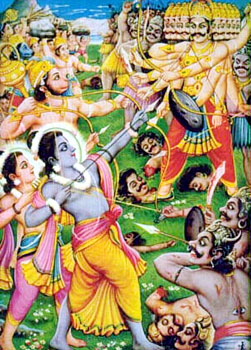
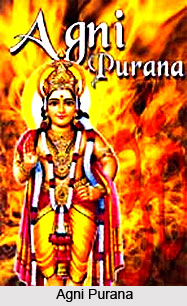
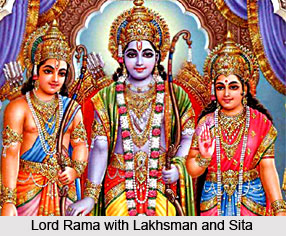
 It has been enumerated by Lord Rama in the Agni Purana that a king should earn money by just and honest means and take special care to accumulate and augment the same, and grant aid in money to none but the deserving. In fact it can be said that these are the four monetary duties, performance of which is obligatory on a king. Lord Rama has said that humility is the father of virtue, and humility springs from a perusal of the scriptural literature. From humility follows the control of the senses, and a king, who has acquired a mastery over his passions and appetites, is the fittest person to rule the world. A man who is possessed of such virtues as knowledge, wisdom, fortitude, perseverance, eloquence, energy, wit, large-heartedness, purity, power, amity, self-denial, truthfulness, gratitude, self-control, parentage, and character, is sure to acquire a splendid fortune.
The Purana states that a king should give up all personal greed, lust, anger, revelry, boastfulness and pride, whereby he would be happy. A king should humbly follow the principles and truths laid down in the codes and in the three holy Vedas or in the spiritual; essence, and reduce them to practise in the works of his every day life.
Lord Rama has also said that extinction of all killing propensities, truthfulness, purity, forbearance, kindness and honesty are the virtues which should be cultivated by all Brahmanas and good men. Compassion towards all, conduct of life according to the rules of one`s social order, truthfulness, kindness, charity, and protection of the weak and the indigent, are the factors that constitute the real self of a truly honest man.
According to the sermons of Lord Rama to Lakshmana a life of perfect good (Satpurusha Vrata) is the only vow, which a man should try to observe at all hazards. Since this body, which is an abode of grieves and maladies, is sure to be destroyed either to-day or a hundred years hence and a prudent man should practise virtues only without caring to cater for the appetites of his flesh. A king should never oppress the poor and the helpless for the furtherance of his own interest, since the curse of the poor is sure to confound or overwhelm him with ruin. A king, seeking his own good, should speak to the wicked with the same humble courtesy, as he would have done to his own revered superiors. A man should speak civilly with his friends and foes alike, since it is the gods only who are honey-mouthed, and it is the brutes only who offend the ears with their harsh and discordant sounds. A man should worship the God in a pure and devotional spirit, revere his elders or superiors as the gods, and look upon his friends as his own selves.
A man should please his superiors with bows, the pious with true and sincere service and the gods with good deeds. A very dear friend (Mitra) should be taken with sentiments, a friend (Vandhu) with courtesy, wife and a servant with love and affection, and the rest with urbanity.
Lord Rama has also said a good man should not interfere with the workings of his neighbours, but attend to his own duties without speaking ill of any body. Kind words should be spoken to the poor and the indigent and sweet words should be used in conversing with all. A generous man sacrifices his own life for the good of a true and tested friend, embraces a guest at his door, succours the distressed to the best of his means, endures all sufferings with the greatest reticence, does not feel elated at this own success, nor envies his thriving neighbours nor gives up friendly conference with men though insulted by them.