 Dance culture inspired by Rabindranath Tagore (1861-1941) represents not only an era of vibrant creativity, but also a breakthrough in the modernization of the Indian dance scene. It is surprising how in a period of classical dance revivalism, Tagore felt the need for modern tools to express his poetic mind. His prolific output of dance scripts and compositions covers a vast range from narratives to abstract images, demanding a wide selection of dance vocabulary. In Santiniketan, he encouraged young dancers to draw material from different classical sources and folk traditions. He kept his doors open to ideas from both the Eastern and the Western worlds. In this way, his concept of dance became enriched, while still remaining deeply rooted in Indian culture.
His eagerness to develop a contemporary style of dance is evident from his restless search for a dance language from different parts of India, even across national boundaries. Between 1919 and 1924 Tagore travelled frequently all over India and abroad.
At Shantiniketan, under his guidance, dancers absorbed movements from Kandyan, Javanese, and European folk dances. The poet was fascinated by the freedom of movement in European modern and impressionist dance, while the delicate structure of the Javanese dance-drama inspired him to create an original form of dance-drama.
Tagore`s contribution to the modernization of Indian dance cannot be compared with the revival of ancient dance forms which was taking place elsewhere in the country. He was inspired by tradition to move forward to an artistic future where form and content would match each other through an innovative process. To Tagore, dance was the natural human instinct of spontaneous physical expression of varied emotions.
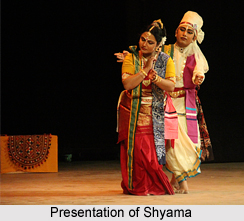
The later period of Tagore`s life is a very important one in the cultural history of India. This was the era of rapid change generated by an awakening of national pride and a questioning of traditional mores like caste discrimination, social hierarchy, and polarity of sex roles. Contemporary literature reflects a drastic change in the attitude towards the male-female relationship and in the expected role models. The thematic content of Tagore`s dance lyrics was undeniably a reflection of his time and often much ahead of it. The mode of presentation, with equal participation of the male and the female on stage, created a visual confirmation of the new era in Indian society.
The poet believed that dance had an important place in a healthy social environment and was meaningful for today`s existence. A collective team of highly gifted musicians, singers, artists, and others worked with a group of young dancers. The rich musical structure of Tagore`s compositions and the depth and subtlety of the imagery of his poetry needed expression in dynamic movements in a style far removed from the classical. The vital period of development of this style can be placed between 1921 and 1940, of which the last years were the most vibrant. In the beginning, dance movements were just embellishments to the songs. Simple and spontaneous movements, mostly from preliminary Manipuri and available folk styles were used. Gradually the poet gave more emphasis to dance training. He encouraged his young dancers, all trainees, to learn more and improve their technique. In later years Kathakali and Manipuri were taught by gurus from Kerala Kala Mandalam and Manipur. During Tagore`s lifetime, various types of Indian and international styles were also imbibed into dancing.
The thematic content of Tagore`s dance-dramas, songs, and poetry called for innovation in the technique of dancing. His themes reflected the ethos of the modern age. Below are two examples of his narrative-
Chandalika
 This is a reinterpretation of a Jataka story. In Tagore`s storyline, the women have a vibrant sexuality of local culture, not under the oppressive Brahman tradition. Prakriti, the heroine, rebels against the practice of caste discrimination. In the prose-play she addresses the Buddhist monk Ananda: "1 have brought you down to the dust.... Otherwise, how would you rescue me from it?"
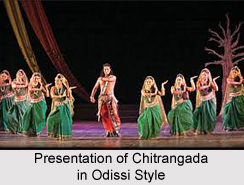
Chitrangada
This dance-drama is a fresh interpretation of the Mahabharata legend with a redefinition of the male-female relationship. Towards the end of this romantic dance-drama the warrior princess affirms: "I am Chitrangada, the princess and not a devi, nor an ordinary woman. I am not the one to be placed above and worshipped; or to be left behind as a subordinate. Only when you let me be by your side in prosperity and adversity will you then know me."