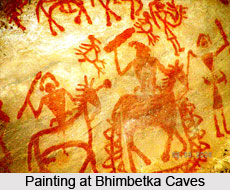
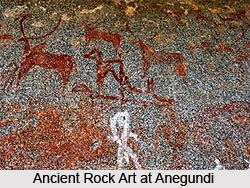
 Rock art of Anegundi village, which is present Gangavathi Taluk, Koppal District in Karnataka is well-known for the unique forms of cave paintings presumably practised by pre-historic human settlement called `Onake Kindi` who inhabited this part of the country millions of years ago. Anegundi rock art includes beautiful rock-art characterised by white and red markings over the surfaces of rocks, along with figures of bulls and humans. Certain rocks also consist of paintings portraying circular diagrams representing celestial bodies like moon and the sun. Historians believe that Anegundi rock art dates back to the Iron Age, constituting the period around 1500 BC. A certain form of megalithic style of burial is also exhibited in a pale, circular painting which also comprises a human body at the centre, overlapped by burial goods and a stone circle.
The paintings are existent inside the mountain ranges which are regionally referred to as `Elu Gadda Salu`, based about 1.5 kms away from Anegundi. The local inhabitants of Anegundi call the megalithic rocks as `Mourya Mane` meaning `short` as moray implies short as per the local dialect. The sketches were those of men and women, while the most common ones were those reflecting the regular scenes of hunting. One will observe that the pre-historic population utilized bows and arrows and similar weapons for the purposes of hunting wild beasts, and rode on creatures like horses, from their paintings.
The painting of a large snake, on one of the Anegundi rocks is considered to be one of the largest drawings on the rocks. Animals like dogs and insects resembling crabs or scorpions have been the other subjects of the rock art at Anegundi. There exists one extraordinary art-form which depicts a huge bird carrying three people over its back, which is believed to be imaginary by few people. However, few other historians are of the opinion that the pre-historic men might have spotted a supernatural being flying along with three people on its back. Some of the rock paintings of Anegundi are unique and are not found at any other places in the world. It is said that the paintings were composed of red laterite clay and is nearly 4000 years of age.