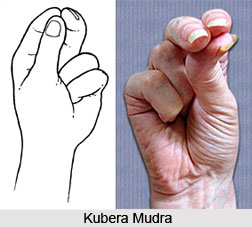
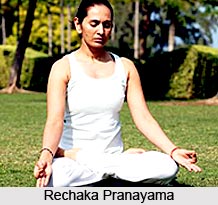
 Recaka begins with the relaxation of the chest. An Ujjayi Yogi, who performs the Recaka, executes it through the left nostril. As long as one continues doing this technique, the exerciser must not lose control of the lungs. Also the loosening of the chest should be sluggish and also consistently `progressive` to the end.
Through out this, the `glottis` should be kept partially closed. A `frictional` sound that is made because of this partial closing, should be a low and also has consistent pitch.
The procedure of doing Recaka at the time of Ujjayi exercise:
In the beginning of Recaka, the muscles of the abdomen undergo larger and larger contraction. Even when the chest compresses to its lowest size, the abdomen should go on contracting till its utmost limit of inhaling air is ejected. However this activity of compressing abdomen put any kind of extra pressure on the body. Only it means that breathing out should be as thorough as can be achieved without a bit strain occurring. Amongst all the techniques of Ujjayi asana, the yogi finds this Recaka the least arduous one.
Another thing to be noted in case of Recaka is that it involves less possibility of creating harm to the lungs than the human heart. Recaka technique must always take quite a long time.
Here again one has to keep in mind that Recaka should under any circumstance be so stretched that it can as a consequence allow the air inhalation that follows to be very rapid and fast. One should practice all the techniques of Ujjayi exercise, including Recaka, as per one`s comfort level and never over exert. However, Recaka technique varies depending on the bodily posture that Ujjayi exerciser has chosen for doing the practice.
For example, if at a sitting one wishes to carry on the Ujjayi exercise, for quite a prolonged period, one must not feel the urge of grasping a normal breath in between any of the two consecutive rounds of Ujjayi. This normal breathing continues till all the rounds of Ujjayi that he undergoes come to an end. No excessive sense of suffocation should be felt at any phase in the practice of Ujjayi, whatever the number of rounds that one wishes to have at one time.