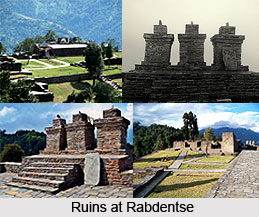
 Rabdentse, the 2nd capital of the earlier Kingdom of Sikkim, is located near Pelling, in the district of West Sikkim, in Northeastern state of Sikkim. Rabdentse was the capital of Sikkim from 1670 to 1814, and the city was destroyed the Nepali army, who invaded the kingdom. Currently, only the ruins of the palace and the stupas are present here. Pemayangtse Monastery, one of the oldest monasteries in the state, is located in close proximity to the Rabdentse ruins.
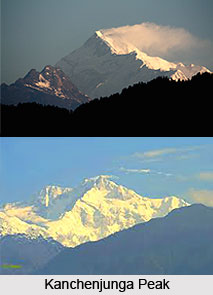
Rabdentse was established as the capital of Sikkim kingdom by the son of Phuntsog Namgyal, named Tensung Namgyal, the 2nd Chogyal or king of Sikkim, in 1670. The capital was shifted from Yuksom, which was sanctified in 1642. The Archaeological Survey of India has declared that the ruins at Rabdentse are of National Importance. The panorama of the Kanchenjungha peak, from the vantage point, is an awe-inspiring view. The ruins of Rabdentse are part of popular religious pilgrim sites of the Buddhist, which also includes, Dubdi Monastery, Khecheopalri Lake, Norbugang Chorten, Pemayangtse Monastery and Sanga Choeling Monastery. The Rabdentse ruins have been well preserved by the Indian Archeological Society and attracts several tourists, reminiscent the royal aspect of the region.
History of Rabdentse
Tensung Namgyal had three wives, a Tibetan, a Bhutanese and a Limbu. Chador Namgyal, the king`s son from his 2nd wife, became the ruler of Sikkim in 1700, after his father`s death. Pendiongmu, daughter of Tensung Namgyal`s first wife, was outraged by this. She evicted Chador, but he eventually returned after several years and reclaimed his position as the ruler. Pendiongmu, of Bhutanese descent, again opposed Chador and had him murdered in 1716. Immediately, the royal army executed Pendiongmu and her associates. In 1717, Gurmed Namgyal succeeded his father Chador. There were several conflicts between the Sikkimese and Nepalese during his reign. Before his death in 1733, he revealed that Sanga Cheoling, a nun, was carrying his offspring.
 The illegitimate child of Gurmed, Phunstog Namgyal II, became the king of Sikkim in 1733. During his reign also, there were several attacks from the Nepalese and the Bhutanese. Nepal appropriated most of Sikkim during the rule of the next king, Tenzing Namgyal, who was a weak king. He eventually fled to Lhasa and in 1780. His son, Tshudpud Namgyal, returned to reclaim his succession in 1793. He subsequently, moved the capital to Tumlong.
Due to the repeated attacks and invasions by the Nepalese and Bhutanese, over the years, Rabdentse was condensed into a ruin by the Nepalese army.
Structures of Rabdentse
The ruins at Rabdentse now contain wall stumps. There is a decorative yellow entrance gate, close to the Pelling-Geyshing road. There is a 15 minutes trek path from the road to the site that goes through a lake and forested hills. There is a stone throne which comprises of 3 standing stones, called Namphogang. The Taphap Chorten, a stupa, is located ahead in a partly ruined state. This was the main entrance to the ancient palace. The ruins of the palace are at the middle of the 4th courtyard. The ruins are segmented into 2 wings, northern and southern. The northern wing, which served as the residence of the royal family, has n open quadrangle, and the damaged Dab Lhagang is present here. In the area, where the Risum Gompa was once situated, lies a white big marble slab. Beside the palace ruins, there are 3 more chortens, where the royal family conducted religious rituals. The chortens are still well preserved.
The Archaeological Survey of India has declared Rabdentse ruins as a Heritage Monument and has taken adequate measures for proper preservation and restoration.