Contemporary Punjabi theatre talks of the prevailing atmosphere in the theatre world of
Punjab. A significant section of Punjabi and
Hindi theatre (which emerged in the nineteenth and early twentieth centuries respectively) has engaged itself with subjects derived from myth, legend, and history of India.
The choice might have been partly a pragmatic one because the narratives from the past provided a structure of shared beliefs; yet it was also a conscious attempt to infuse the country with cultural vitality and to awaken the national spirit. The past was invoked to portray models of endurance, self-sacrifice, courage, and undaunted resistance in the characters of
Sita,
Savitri, Abhimanyu, Maharana Pratap, Rani Padmini, and others to inspire the writers` countrymen to fight against oppression and colonial rule. The return to the past was inevitably characterised by reformed romanticism which countered the colonizer`s image of the inferior, the barbaric and the uncivilized of the colonized. However, in the post-colonial phase, the use of myth, legend, or history is problematic and multidimensional; in addition to using the past to clarify and comment on the present, playwrights (particularly from the sixties onwards) present a critique of their own cultural traditions which they confront, question, subvert, and at times even reject.
Legends of contemporary Punjabi theatre speak about the various aspects of
contemporary Punjabi theatre. Legend, despite its specific differences from myth, performs similar psycho-social functions. Like myth, legend is a cultural construct which records, presents, and further regulates and validates the moral system of a society.
The legends of the
Punjab, going back to medieval times and before, are essentially patriarchal in their values and structure, whether as the legends of love or those of morality which posit models of ideal human conduct. The woman stands either marginalized or misrepresented; at the most she is a person of no consequence who is unfit to be noticed, and at her worst she is an evil, wicked temptation ever ready to entice man, someone against whom the virtuous man should carefully guard himself.
While playwrights of an earlier age were content to focus on the images of woman glorified in the myths, of woman steeped in endurance, self-sacrifice and steadfast virtue (for example, Brij Lal Shastri`s plays Savitri and Sukanya (1925) derived from the
Mahabharata), playwrights in the postcolonial phase focus instead on the image of the wronged woman and recreate legends from her point of view. Even though drama in the Punjab, as in the rest of India, remains men`s forte, the contemporary renderings of the traditional patriarchal narrative take a feminist form in a bid to make them more realistic, just, and open to question and analysis.
One of the numerous popular love legends of the Punjab is the legend of "Heer Ranjha" of the sixteenth century. In various renderings of the legend and in proverbial utterances, Sahiban is a byword for the infidelity of woman. Contemporary playwrights not only redeem these women from the charge of infidelity and betrayal, but also present them as more complete, complex, and humane persons in comparison with men, who, blinded by their egos, have only a partial understanding of life and who are, in fact, responsible for women`s suffering. While maintaining the broad outlines of the narratives of the past, by slightly shifting the emphasis in character or incident or by filling in some gaps the playwrights attempt to draw attention to certain unjustified assumptions and fallacies in the legends.
In his one-act play Heer da Dukhant (The Tragedy of Heer, 1982) Harsaran Singh focuses on the moment when Ranjha reaches Heer`s in-laws` house, highlighting how Heer has been wronged both by her husband and by her lover. Working on the argument at greater length in a later play Heer Ranjha (1990), Harsaran Singh dramatizes the entire narrative and reveals how Heer is in fact wronged by all the men in her life, by her father who forces her to marry Saida in the name of family honour even after she has revealed the true identity of Ranjha as the son of a chieftain, by her lover who failed her when she offered to elope with him but later reaches her in-laws` house in the guise of a fakir, and by her husband who neither fulfils the duty of a husband in that he does not protect her from the fakir nor accepts her leaving the house and runs after her with a sickle to murder her.
Ajmer Singh Aulakh, in his one-act play Bal Nath de Tille Te, 1978, vindicates woman by giving Ranjha a language different from that in the legend. Woman`s love is glorified as the love of God. The play recounts the moment when Ranjha goes to Guru Bal Nath to become a Jogi after Heer is married to Saida.
Several playwrights have been fascinated with Sahiban`s character that, unlike other Punjabi heroines, is torn between the contrary pulls of natural desire and filial commitments. They variously have tried to redeem her from the charge of betrayal.
The biased and simplified discourse of the legend becomes complex and more realistic in modern plays, wherein women grow into fully developed characters and cease to be mere `functions` in the grandiloquent design of the narratives glorifying man. Even though most of these plays coincide with the revival of the feminist movement in the West, they are not the result of any women`s movement in the Punjab. Interestingly, all these feminist variations of the traditional discourse are created by male playwrights, with the exception of Sundran. The distinction is significant, though. The feminism of the male playwrights forms part of their larger, more generally humanistic vision, which believes in the essential humanity of all people and subscribes to an ethos of dignity, respect, freedom and justice for all human beings; when these principles are violated, the playwrights use their dramas to speak for the violated victim. With Manjit Pal Kaur the rendering afresh of the legend is a conscious and more specifically ideologically feminist statement. As a result, while other protagonists, despite their protest and rebellion, continue to remain victims of patriarchy, Sundran transcends the patriarchal structure of the legend: she would not commit suicide, she is `incomplete` but not utterly dependent on Puran, her sexuality and motherhood are realised at her own will and not at the dictates of man. Even more significantly she substitutes for the patriarchal order of binary oppositions of the oppressor and oppressed, the ruler and the ruled, an alternative vision of complementarily of man and woman where both can live in mutual harmony and reciprocity instead of one having to suppress the other for one`s own being.
To impart a dramatic structure to the meandering narratives of the legend, these playwrights turn to indigenous theatrical traditions, both classical and folk. From Sanskrit drama they derive the characters of the Sutradhar (i.e., the director, controller or stage-manager, though literally it means `one who holds the strings`) and Nati (actress) and adapt them to individual requirements. In Sundran they are given the traditional role of introducing the play and stand outside the body of the play. In Luna, Shiv Kumar extends their traditional role by giving a long first scene to them. They figure as creatures from heaven that on one side in rich poetic delight dwell on the beauty of this earth and on the other question the `irrational` cruel practices like animal sacrifice to be performed by the king. In Mirza Sahiban, Balwant Gargi gives the Sutradhar a recurrent appearance in the play, and he punctuates the action with his comments.
From the folk theatres the playwrights derive a narrator-like character to sum up the action and to direct the audience`s attention. For example, the Dhadi, a folk-singer who traditionally sang these legends, is a frequent choice, serving as a chorus who sings excerpts from the legend while the action progress, sometimes in accordance with the legend and sometimes contrary to it. Gargi makes a pronounced use of this character. Others, like Harsaran Singh in Heer Ranjha, Ghumman in Rani Koklan, and Bahrla in Sahiban, prefer to use a Voice, which creates the effect of timelessness, similarly to narrate the legend; or to sum up and comment on the action; or to externalize the feelings of the characters. In Rani Koklan a chorus is also used, first to sing excerpts from the legend and then to counter it by pointing to Koklan`s experience. Scenes flow one after the other with simple alternation of darkness and light. Like the poetic narratives of the legends, many of these plays are poetic plays, e.g. Luna, Sahiban, Sundran, and Aulakh`s one-act plays. Even those written in prose are frequently interspersed with excerpts from the legends and snatches of folk songs and closely maintain the poetic rhythm of the legends, while occasional introduction of folk dances like Gidhha and Bhangra add to the folk atmosphere. Engaging themselves with the paradigms of the oppressor and the oppressed in the larger socio-cultural context, the post-colonial playwrights in the Punjab thus realize their creative instinct in their own native linguistic and cultural context by updating the traditional discourses as well as theatrical conventions.
During the 1940s, there emerged a significant
Punjabi theatre in Lahore. But the partition of the country was responsible for checking its growth. Uprooted from its nuclear cultural centre of Lahore, theatre activity received a serious setback when it dispersed to
Shimla,
Jalandhar,
Patiala,
Amritsar,
Delhi, and later,
Chandigarh. Nowhere could it make its presence felt. In all these places, Punjabi theatre remained a localized affair with no distinctive character of its own.
Punjabi Theatre and Its Present Position
The early Punjabi theatre catered primarily to the urban middle class, and its intent was to bring about social reform. Whatever the conflicts presented, these plays focused on the domestic and the romantic. The characters were generally stock types, and the denouement proceeded on familiar lines. According to Sant Singh Sekhon,
Punjabi theatre in its early days was rhetorical, with emotions and sentiments having great importance.

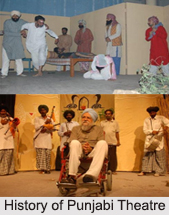 History of Punjabi Theatre, in its early days was rhetorical, with emotions and sentiments having great importance. Theatre activity in Punjab was triggered by militancy. Most of the theatre groups concentrated on the Punjab problem and churned out scripts and staged plays on this problem. Hence, Punjabi theatre remained a localized affair with no distinctive character of its own.
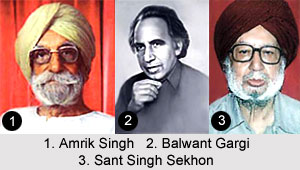 Punjabi theatre between 1931 and 1947 was mainly dominated by playwrights of the modern