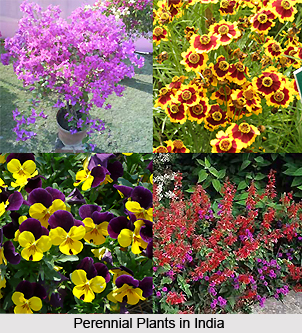
 Trees and shrubs are technically woody perennials, but in general usage, the term perennial is restricted to non-woody perennials. In warmer and more clement climates, perennials grow continuously. In seasonal climates, their growth is limited to the growing season. For example, in temperate regions a perennial plant may grow and bloom during the warm part of the year, with the foliage dying back in the winter. These plants are deciduous perennials. Re-growth is from existing stem tissue. With their roots protected below ground in the soil layer, perennial plants are notably tolerant of wildfire. They are also less subject to extremes of cold in temperate and arctic winters, with less sensitivity than trees or shrubs.
The perennial plants in India dominate many natural ecosystems on land and in fresh water, with only a very few (e.g. Zostera) occurring in shallow seawater. They are particularly dominant in conditions too fire-prone for trees and shrubs, e.g., most plants on prairies and steppes are perennials; they are also dominant on tundra too cold for tree growth. In forests, perennial plants are of secondary importance to trees and shrubs, but are often still abundant on the forest floor. Perennial plants are usually better competitors than annual plants, especially if grown under stable and resource-poor conditions.This is due to the development of larger root systems, which can access water and soil nutrients deeper in the soil and to earlier emergence in the spring. Perennial plants can be purchased in India in a number of ways. The most common way is plants in quart, one or two gallon containers. These plants are already growing and afford the gardener the elasticity to select and plant through the growing season. Another way is bare-root or packaged plants. These are obtained through mail order or at garden centers and are sold as inactive material. These plants are available for spring planting only. Bleeding Heart, Water Lily, Gerberas, Geraniums and Anthuriums are some of the best examples of perennial plants in India.