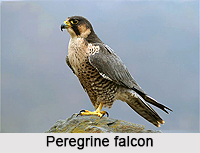
 Peregrine Falcon is an Indian bird with a scientific name "Falco peregrinus", also known as the peregrine, and historically as the duck hawk in North America.
Peregrine Falcon is a widespread bird of prey in the family of Falconidae. A large, crow-sized falcon, it has blue-grey back, barred white under parts, and a black head and "moustache". As is typical of bird-eating raptors, peregrine falcons are sexually dimorphic, females being considerably larger than males.
Peregrine Falcon is renowned for its speed, reaching over 322 km/hour during its characteristic hunting stoop (high speed dive), making it the fastest member of the animal kingdom.
Breeding of Peregrine Falcon
The breeding range of Peregrine Falcon includes land regions from the Arctic tundra to the tropics. It can be found nearly everywhere on Earth, except extreme polar regions, very high mountains, and most tropical rainforests; the only major ice-free landmass from which it is entirely absent is New Zealand. This makes it the world`s most widespread raptor and one of the most widely found bird species. In fact, the only land-based bird species found over a larger geographic area is not always naturally occurring but one widely introduced by humans, the rock pigeon, which in turn now supports many peregrine populations as a prey species.
Feeding of Peregrine Falcon
The diet of Peregrine Falcon consists almost exclusively of medium-sized birds; the Peregrine falcon will occasionally hunt small mammals, small reptiles, or even insects. Reaching sexual maturity at one year, it mates for life and nests in a scrape, normally on cliff edges or, in recent times, on tall human-made structures.
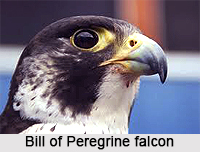
Peregrine falcon as Endangered Species
Peregrine falcon became an endangered species in many areas because of the widespread use of certain pesticides, especially DDT.
Structure of Peregrine Falcon
Peregrine falcon has a body length of 34 to 58 cm and a wingspan from 74 to 120 cm (29-47 in). The male and female have similar markings and plumage, but as in many birds of prey the peregrine falcon displays marked sexual dimorphism in size, with the female measuring up to 30% larger than the male. Males weigh 330 to 1,000 g (0.73-2.20 lb) and the noticeably larger females weigh 700 to 1,500 g (1.5-3.3 lb). In most subspecies, males weigh less than 700 g (1.5 lb) and females weigh more than 800 g (1.8 lb), with cases of females weighing about 50 percent more than their male breeding mates is not uncommon.